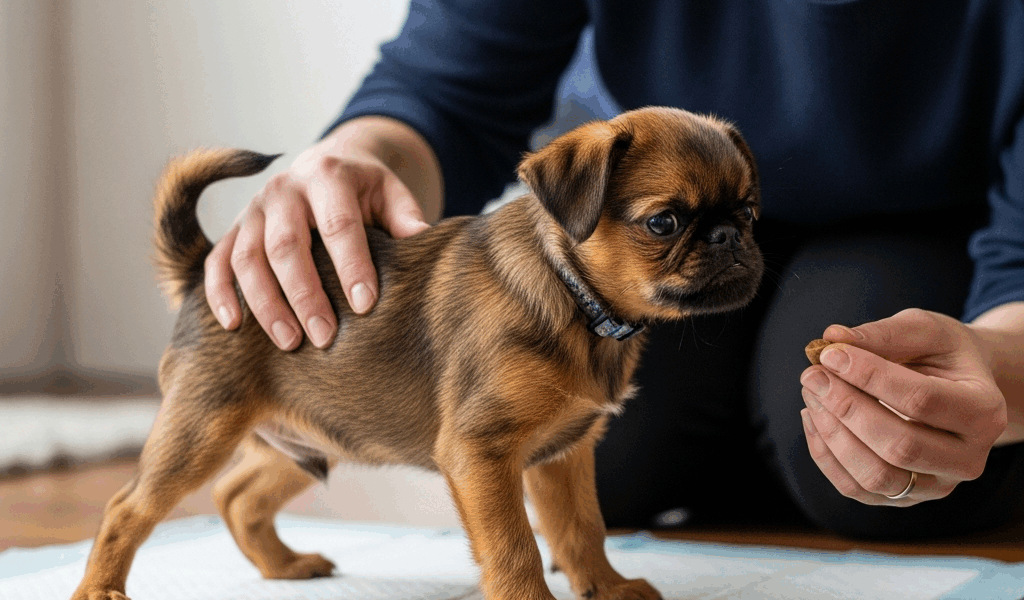
Brussels Griffon Potty Training — Why It Is Hard and What Actually Works
I’ve owned dogs my entire adult life. Trained a rescue mutt with serious behavioral baggage. Housebroken a notoriously stubborn Shiba Inu in three weeks flat. None of that prepared me for my Brussels Griffon, a red rough-coat named Bram, who took the better part of eight months to get reliably clean in the house. Methods that worked fine on every other dog I’d owned failed spectacularly on him. What I eventually figured out — through trial, error, and a genuinely embarrassing number of paper towels — is that this breed needs a different approach from the ground up.
Why Brussels Griffons Are Harder to Potty Train Than Most Dogs
Most potty training guides treat housebreaking like a universal process. Take dog outside, reward dog, repeat. For a lot of breeds, that works well enough. Brussels Griffons are a sensitive, opinionated small dog with a bladder to match their frame, and the combination of traits they carry will derail every shortcut in the standard formula.
The Bladder Problem Is Real
Griffons typically weigh between 8 and 10 pounds as adults. Their bladders are tiny — physically, structurally small. A puppy under 12 weeks genuinely cannot hold it for more than 45 minutes to an hour. Even adult Griffons rarely have the same capacity as a 30-pound dog. I used to watch Bram squat in the hallway with an expression suggesting absolutely zero awareness that anything unusual was happening. No warning. No circling. No sniffing. Just — done. Four seconds, maybe less.
That speed is a real issue. Larger dogs give you signals — they circle, they sniff, they make eye contact in a way that reads as deliberate. Griffons often just quietly crouch and go. By the time you look up from your phone, the accident is over and they’ve moved on to chewing a sock.
The Temperament Factor
Brussels Griffons are not Labrador Retrievers. They are not eager to please in that retrievery, tail-wagging, what-do-you-need-from-me way. They are sensitive, opinionated, and prone to shutting down entirely if they feel criticized. Harsh corrections — even a firm “no” in the wrong tone — can make a Griffon sulk, hide, and start finding sneakier indoor locations rather than learning anything useful. I raised my voice at Bram exactly once during a training session. He refused to make eye contact with me for two full hours afterward. He was four months old.
This matters for potty training. Punishment-based correction, which works acceptably with many breeds, actively backfires here. You don’t get a dog that learns not to go inside. You get a dog that learns not to go in front of you — so they start hiding to eliminate. Genuinely worse than where you started.
Weather and Outdoor Refusal
Cold weather refusal is not a behavioral quirk in Griffons. It’s practically a breed characteristic. Anything below 45 degrees and Bram treated the backyard like a war zone. Rain was even worse — he would stand at the back door, stare at the wet grass, and then look back at me with an expression of pure contempt. Rough-coats have slightly better tolerance than smooth-coats, but honestly, neither coat type is built for January mornings.
The Schedule That Works for Brussels Griffons
Everything else — the crate setup, the reward system, all of it — collapses without a reliable schedule underneath it. Griffons don’t generalize bathroom timing the way some breeds do. They need structure imposed from outside until the habit forms on its own.
Frequency by Age
The general rule is one hour of bladder control per month of age, plus one. For Griffons, I round down. Here’s what actually worked for Bram:
- 8 to 12 weeks — outside every 45 minutes during waking hours, no exceptions
- 3 to 4 months — every 60 to 90 minutes, immediately after waking, eating, and any play session
- 4 to 6 months — every 2 hours minimum, with mandatory trips after every meal and every nap
- 6 to 12 months — every 3 to 4 hours, but expect regression around 6 to 8 months
Set a timer. Genuinely, set a phone timer. I used the stock iPhone clock app and set repeating 90-minute alarms labeled “BRAM OUTSIDE” for the first three months. It felt excessive. It wasn’t.
Feeding Schedule and Bathroom Predictability
Free-feeding — leaving food out all day — is the enemy of potty training. A dog that eats unpredictably eliminates unpredictably. Griffon puppies should eat two to three measured meals per day at consistent times. Bram got 1/4 cup of Orijen Puppy Small Breed at 7am, noon, and 5pm. Within 15 to 20 minutes of each meal, he went outside — every single time. That predictability is something you can actually work with.
Same principle applies to water. Don’t restrict it during the day, but pick up the bowl about two hours before bedtime to help get through the night. At 10 weeks Bram still needed a 2am outing. By 14 weeks he could make it from 10pm to 6am.
Crate Training a Brussels Griffon Without Breaking Trust
Bram’s first week in a too-large wire crate was a disaster. I returned it and started over with a 24-inch Midwest iCrate single door model, the 24″ x 18″ x 19″ size specifically, with the divider panel installed to make the interior just large enough for him to stand, turn, and lie down. Nothing more.
Size Is Not Negotiable
A crate that’s too large gives a Griffon options. They will sleep in one end and eliminate in the other, defeating the entire purpose. The divider panel that comes with most wire crates lets you expand the space as the puppy grows. Start small. Genuinely small. The dog should not be able to take more than two steps in any direction.
Introduction Has to Be Slow
Brussels Griffons develop separation anxiety at a higher rate than most breeds. Forcing crate introduction — putting the puppy inside and closing the door immediately — creates panic responses that undo weeks of trust-building. Here’s the process I followed, spread across about five days:
- Day 1 and 2 — crate door open, treats tossed inside, no pressure to enter
- Day 3 — feeding meals inside the crate with door open
- Day 4 — closing door during meals, opening immediately after eating
- Day 5 — short closures of 10 to 15 minutes while staying in the same room
- Day 6 onward — gradually increasing duration, introducing out-of-sight time
I put an old sweatshirt in the crate, one I’d worn the day before, nothing washed. Bram settled faster with something that smelled like me. A Snuggle Puppy heartbeat toy, around $40 at most pet stores, helped during the first two weeks at night. Sounds like a gimmick. It worked.
The Crate Is Not a Punishment
Never put a Griffon in the crate after an accident as a consequence. They won’t connect those two events — they’ll just associate the crate with negative feelings, which poisons the one tool that makes nighttime and unsupervised hours manageable.
What to Do When Standard Methods Are Not Working
Standard methods often don’t fully work with this breed. Not a failure on your part — it’s just a Griffon.
Belly Bands — Management, Not Training
Belly bands are wrap-around bands that hold an absorbent pad against a male dog’s belly. They don’t teach anything. They protect your floors and furniture while training is ongoing. I used Simple Solution Disposable Belly Bands — pack of 12, about $14 at Chewy — during the 6-month regression period when Bram started marking inside after we moved apartments. Female dogs can use dog diapers the same way. The point is buying yourself time without letting the bad habit rehearse itself unchecked.
Indoor Pee Pad Stations
For apartment dwellers, people without yard access, or anyone dealing with a Griffon in January — an indoor bathroom station is not a failure. It is a reasonable accommodation for a breed that will flat-out refuse to go outside in bad weather and then eliminate behind the couch 20 minutes later. Fresh Patch makes a subscription grass replacement service that works well in city apartments. Train it the same way you’d train an outdoor spot: specific command, consistent reward, consistent location.
When to Consider a Medical Cause
Rule out a medical issue first if the accidents came on suddenly after a period of reliability. Urinary tract infections are common in small breeds and present exactly like behavioral regression. Bram had one at 7 months. Cost about $65 for the office visit and urine culture at our local vet in Portland. A week of antibiotics fixed what I had been blaming on adolescent stubbornness for nearly two weeks.
Regression at 6 to 8 Months Is Normal
Almost every Brussels Griffon owner I’ve talked to — and I’ve talked to a lot of them through the Brussels Griffon National Rescue Facebook group — reports a regression window somewhere between 6 and 8 months. Hormonal changes, increased independence, new environments. It’s real. It’s temporary. Go back to basics: tighten the schedule, return to mandatory post-meal outdoor trips, re-establish the crate routine if it’s lapsed.
Bram is reliably clean now. Has been for about two years. The process was longer and more specific than housebreaking any dog I’d owned before, and it required me to throw out assumptions I’d built up from working with other breeds. The Griffon-specific approach — tight schedule, positive-only correction, right-sized crate, weather accommodations, patience through the regression — actually works. It just works on a Griffon timeline, which is its own thing entirely.


Stay in the loop
Get the latest griffist updates delivered to your inbox.