Brussels Griffon Reverse Sneezing — When It Is Normal and When to Call the Vet
My griffon, Marzipan, did it for the first time about three weeks after I brought her home. Frozen at the foot of the bed, neck stretched forward, making this horrible repetitive honking-snorting sound — like a goose being slowly compressed. I was on the phone with an emergency vet within ninety seconds. The vet explained, very kindly, that what I’d just described was almost certainly a reverse sneezing episode. Completely benign. Probably scared me far more than it scared Marzipan. She was right on all counts.
That said, there are real situations where reverse sneezing in a Brussels griffon warrants immediate attention. Knowing the difference matters enormously for this breed specifically, and the internet is roughly split between “it’s nothing” and “your dog is dying” with very little useful ground in between.
What Brussels Griffon Reverse Sneezing Looks and Sounds Like
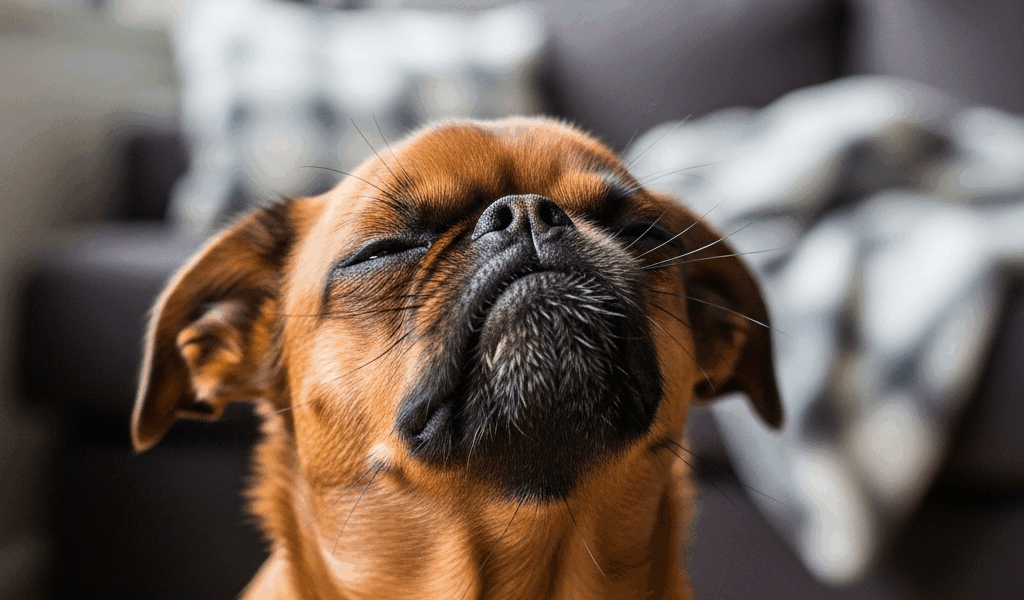
The behavior has a very specific signature once you know what you’re watching for. The dog stops moving entirely. Head extends forward and downward, neck stretched long. Elbows sometimes splay slightly outward. Then come the rapid, forceful inhalations — not one or two sneezes, but a rhythmic series of them, anywhere from five seconds to about two minutes, with a honking or snorting sound on each breath in. The dog’s sides may heave. Eyes sometimes bulge slightly.
It looks like choking. It looks like a seizure. It looks like the beginning of something catastrophic. It isn’t.
A regular sneeze is a single explosive exhalation — over in a fraction of a second. Reverse sneezing is the opposite. Rapid, repeated inhalation through the nose, caused by a spasm of the soft palate and throat muscles. The dog is pulling air in hard and fast, not pushing it out.
What It Is Not
Choking, in this context, means the dog is pawing at its mouth, retching, showing distress that escalates rather than resolves. The escalation is the tell. Reverse sneezing ends as abruptly as it started. Marzipan would shake it off and trot toward her food bowl like absolutely nothing had happened. If an episode doesn’t resolve within two or three minutes, or if the dog seems genuinely unable to breathe between honks, that’s a different situation entirely.
Tracheal collapse also sounds similar to the untrained ear. The difference is that the cough associated with tracheal collapse tends to happen during or after exercise or excitement — it produces a harsh “goose honk” cough rather than rapid inhalations, and it’s often accompanied by breathing difficulty that lingers well past the episode itself. Reverse sneezing clears completely. The dog between episodes should breathe normally, behave normally, and show zero respiratory distress.
Why Brussels Griffons Do This More Than Other Dogs
Understanding the anatomy makes everything else click into place, so I should get into this before anything else.
Brussels griffons are brachycephalic. That compressed, flat-faced skull structure is the entire reason the breed looks the way it does, and it’s also why their respiratory anatomy is inherently more complicated than a Labrador’s. Three anatomical features are at play. First, stenotic nares — narrowed nostrils that restrict airflow. Hold your nose mostly closed and breathe hard. That resistance is what your griffon navigates on every single breath. Second, an elongated soft palate — the soft tissue at the back of the roof of the mouth hangs slightly into the airway. In a longer-skulled dog, this tissue fits comfortably. In a griffon, the same length of tissue is packed into a shorter space. Third, a narrowed nasopharynx — the passage connecting nose to throat — which is just structurally tighter in brachycephalic breeds.
Any minor irritant — a dust particle, a humidity shift, eating too fast, a burst of excitement, sleeping in a weird position — can trigger that soft palate to spasm against the back of the throat. The spasm causes the rapid inhalations. The dog is essentially trying to clear or reset the airway. This is not a defect unique to your dog. It is a direct consequence of the skull shape that defines the entire breed. Every griffon owner I know has been through the first-episode panic.
Other brachycephalic breeds — pugs, French bulldogs, Boston terriers — deal with the same thing. But griffons, particularly because of their small overall body size (typically between 8 and 12 pounds) seem to have episodes that are proportionally more dramatic-looking relative to their frame. Big sound, small dog.
How to Help Your Griffon During an Episode
Jolted awake by Marzipan’s first 2 a.m. episode, I made every wrong move available. Grabbed her. Tried to look in her mouth. Made worried noises. Turned on all the lights. All of that made things worse. Here’s what actually helps.
Cover the Nostrils Briefly
Gently place one finger over both nostrils for just one or two seconds. Not hard. Not long. The goal is to prompt a swallow reflex — when the dog swallows, the soft palate repositions and the spasm typically breaks. This works about 70% of the time in my experience. Some owners use a thumb and forefinger in a gentle pinch. Gentle is the key word.
Massage the Throat
Slow, gentle strokes along the underside of the throat — chin toward chest — can help relax the spasming muscles. Some dogs respond better to this than the nostril trick. Marzipan likes the throat massage. She leans into it now, which is both helpful and slightly absurd.
Stay Calm
Harder than it sounds. Dogs read our emotional state with embarrassing accuracy. If you panic, crouch down looking horrified, and start speed-dialing the emergency vet, your dog picks up on that distress and it can extend or intensify the episode. Sit down. Talk in a normal, boring voice. “Hey, buddy. You’re okay.” Keep your energy flat.
What Not to Do
- Do not stick your fingers in the dog’s mouth — you will get bitten, and it does nothing useful
- Do not hold the dog down or restrict movement during the episode
- Do not spray water in the face
- Do not pick the dog up and jostle it
- Do not try to induce vomiting — this is not a foreign body obstruction
Most episodes last under a minute. After it passes, give the dog a few seconds to reorient, then go back to whatever you were doing. Normal behavior resumes fast. Marzipan’s favorite move is to act completely unbothered while I’m still sitting there with my heart rate at 120.
When Reverse Sneezing Means Something Serious
This is where breed-specific knowledge actually matters, because generic brachycephalic articles tend to wave everything away as “normal for flat-faced dogs” without giving owners a real decision framework.
Frequency Thresholds
Occasional reverse sneezing — once every few days, or a cluster of episodes that then disappears for weeks — sits in the normal range for this breed. Multiple episodes per day, every single day, is not something to normalize. That pattern warrants a vet visit to rule out underlying causes: nasal polyps, chronic rhinitis, allergies, early-stage respiratory issues.
Call the Vet Immediately If You See These Signs
- Blue or purple gums — this indicates inadequate oxygenation and is an emergency, full stop
- Labored or noisy breathing between episodes — if the dog isn’t breathing normally outside of a reverse sneezing episode, something structural or infectious needs evaluation
- Nasal discharge — especially if thick, colored, or present on one side only
- Coughing in addition to reverse sneezing — coughing and reverse sneezing are distinct, and the combination can indicate respiratory infection or early tracheal collapse
- Episodes that don’t resolve within two to three minutes
- Loss of consciousness or collapse during an episode — rare, but a true emergency
- Sudden dramatic increase in episode frequency after months or years of stability
Tracheal collapse is worth naming directly here. It’s more common in small brachycephalic dogs than in the general dog population, and it can look deceptively similar to severe reverse sneezing. The distinguishing feature is that breathing difficulty in tracheal collapse does not fully resolve between episodes. The dog sounds congested or wheezy at rest. It coughs when it drinks water. It struggles after brief exercise. If any of those patterns sound familiar, that’s a chest X-ray conversation.
Long-Term Management for Brachycephalic Brussels Griffons
Managing reverse sneezing in a griffon is less about treating a medical condition and more about reducing the triggers that set off the soft palate spasm in the first place.
Weight Management
Extra weight in a brachycephalic dog is not a cosmetic issue. Even one or two pounds above ideal body weight increases pressure on an already compromised airway. A griffon who should weigh 10 pounds but weighs 13 is carrying 30% excess body weight — proportionally significant. This single change reduces episode frequency more reliably than most other interventions. Talk to your vet about your specific dog’s target weight and actually get there.
Harness Over Collar
A collar pressing against the trachea during walks — especially if the dog pulls — is a direct mechanical irritant to the exact anatomy involved in reverse sneezing. Switch to a well-fitted harness. The Ruffwear Front Range (around $45) and the PetSafe Easy Walk (around $25) both work well for small breeds. The collar can stay for ID tags; it should not be the leash attachment point.
Elevated Food Bowls
Eating from a floor-level bowl forces a flat-faced dog to compress its airway further during swallowing. A raised bowl — 3 to 4 inches off the ground — reduces post-meal reverse sneezing episodes noticeably. Slow-feeder bowls help if your dog inhales food, which is a common trigger. Marzipan required both. Floor bowl plus speed-eating was her personal recipe for a midnight honking incident.
Avoid Extreme Heat
Heat and humidity are significant triggers. Brachycephalic dogs regulate temperature through respiration — with an airway that’s already doing extra work at baseline — so hot, humid conditions push that system harder and increase episode frequency. Keep your griffon in air conditioning when temperatures climb above the low 80s. A $30 cooling mat isn’t a luxury item for this breed.
When to Consider Soft Palate Surgery
Brachycephalic Obstructive Airway Syndrome surgery — which can include soft palate resection, nares widening, or both — is a real option for griffons with severe, chronic respiratory symptoms. The surgery directly addresses the underlying anatomy, and no amount of harnesses and elevated bowls resolves airways that are genuinely obstructing breathing at a dangerous level.
The procedure costs between $1,500 and $4,000 depending on what’s being corrected and your geographic area, and it carries the standard risks of any procedure under general anesthesia in a brachycephalic dog (which are higher than average). The conversation about surgery becomes worth having when daily quality of life is affected: consistent exercise intolerance, poor sleep, frequent cyanosis, or reverse sneezing episodes so frequent and severe that the dog is visibly struggling. A veterinary internist or board-certified surgeon — not just a general practitioner — should be involved in that evaluation.
The thing I wish someone had told me the night Marzipan first stood at the foot of my bed honking like a broken foghorn: you will get used to this. Not because you become callous, but because you learn to read your dog. You learn what her normal episodes look and sound like, and that knowledge lets you spot instantly when something is different. That calibration is the whole game with this breed.


Stay in the loop
Get the latest griffist updates delivered to your inbox.