Why Brussels Griffons Struggle With Being Alone
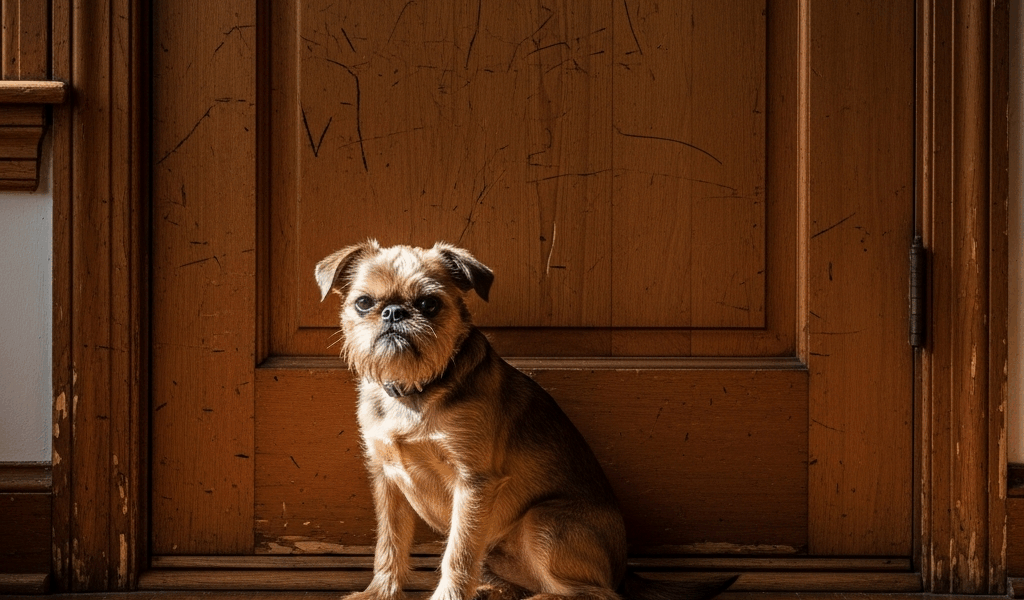
Brussels Griffon separation anxiety has gotten complicated with all the conflicting advice flying around. So let me cut through it. This breed was literally engineered to be a velcro dog — not to herd sheep, not to guard estates. They were lap dogs for Belgian nobility. Companions first, everything else a distant second. Their entire nervous system is wired around one job: staying close to their person.
As someone who brought a Griff home without fully understanding what I was signing up for, I learned everything there is to know about this breed’s emotional architecture the hard way. Today, I will share it all with you.
When you adopt a Brussels Griffon, you’re not getting a dog that happens to enjoy your company. You’re getting an animal whose genetics are essentially screaming “your human is my purpose.” Small size amplifies this. They can’t entertain themselves in a backyard for hours like a Lab might. A Griff five blocks from you might as well be on another planet — at least in their mind.
This isn’t a training failure. It’s not a character flaw. It’s breed architecture. Modern life — eight-hour workdays, errands, social obligations — collides head-on with what these dogs were built to do. Understanding that distinction matters before you spiral into guilt over your schedule or start blaming yourself for the chewed door frame.
Signs Your Griff Has Real Anxiety vs. Just Being Dramatic
Here’s where I need to be honest: Brussels Griffons are theatrical. Wildly theatrical. Mine screams if I step into another room for thirty seconds — like I’ve abandoned her at a bus station with no cash and a broken phone. So how do you actually know if it’s anxiety or just personality?
The key is escalation and focus. Normal Griff drama peaks immediately, then settles. Your dog barks when you grab your keys, maybe for a minute, then parks herself on the couch and watches the window. That’s not separation anxiety. That’s a Griff being a Griff. That’s what makes them endearing to us Griffon people.
Real anxiety looks different:
- Barking that intensifies after you leave, rather than stopping within 5–10 minutes
- Destructive scratching at door frames, baseboards, or window sills — targeting exit points specifically
- Self-soothing that crosses into self-harm: chewed paws, raw spots from repetitive licking, hair loss on legs
- Loss of appetite while alone — your Griff skips meals entirely or only eats once you’re back
- Soiling in the house despite being housetrained and having full bathroom access
- Panting, pacing, or that eerie frozen posture when you’re preparing to leave
Video monitoring is the tool that changed everything for me. I set up a $40 Wyze Cam and actually watched what my dog did after I left — instead of guessing and catastrophizing. Turns out my Griff destroyed the bedroom door frame for the first 20 minutes, barked intermittently for another 40, then crashed hard on the bed. That data let me measure real progress rather than just hoping for the best.
One more thing: drooling. Anxious Griffs sometimes drool excessively under stress. Not glamorous to talk about, but it’s a genuine neurological signal that something’s wrong. Don’t ignore it.
What Makes Brussels Griffon Anxiety Worse Without You Knowing
Probably should have opened with this section, honestly. Most Griff owners — myself included — accidentally fuel the anxiety fire through sheer good intentions. These are the mistakes that happen first, and they’re fixable.
Emotional departures. Your dog is already upset when you head to work. So you kneel down, hold her face, tell her you’ll be back soon, spend five minutes reassuring her at the door. What you’ve actually done is teach her that your leaving is a catastrophic event worth panicking over. Dogs read ceremony, not words. A calm departure — standing up, walking out — signals safety. Drawn-out goodbyes signal disaster.
Inconsistent schedules. Work from home Monday, Wednesday, Friday — gone eight hours Tuesday and Thursday. Your dog’s nervous system never adapts. It can’t build a rhythm. Predictability is calming in a way that nothing else really replicates. Random, unpredictable absences keep her in a state of constant low-grade vigilance. That’s exhausting for a small dog.
Rewarding clinginess with attention. Your Griff follows you to the bathroom, camps on your lap during Zoom calls, sleeps pressed against your legs every night. None of that is inherently bad. But if you respond to her clingiest moments with extra coddling — “Oh, my poor baby, you need mommy right now” — you’ve reinforced the anxiety itself. Independence gets ignored. Dependence gets rewarded. The dog learns accordingly.
Under-exercising before departures. A tired Griff is a calm Griff. A bored Griff is a demolition crew. Leave your Brussels Griffon with no mental stimulation and no physical exercise before you head out, and you’ve built the perfect storm. Even 15 minutes of fetch or sniff work shifts the baseline dramatically.
I made all four mistakes before I understood what I was dealing with. Don’t make my mistake.
Step-by-Step Plan to Reduce Separation Anxiety at Home
So, without further ado, let’s dive in. Desensitization works — at least if you commit to consistency and let go of the idea that this will be fast. Brussels Griffons are smart enough to learn entirely new behavioral patterns. They’re also emotionally flexible enough to update what they perceive as a threat. Both things work in your favor here.
Week one: Neutralize departure cues. Your keys. Your shoes. Your work bag. These objects have become anxiety triggers because they reliably predict your absence. The fix is boring by design — grab your keys and sit back down on the couch. Do this 10 times a day for three days straight. Your Griff stops reacting because the keys stop meaning anything. They’re just keys now.
Weeks two and three: Graduated absences starting at 30 seconds. Leave the room. Close the door behind you. Return after 30 seconds — before she hits panic. Repeat five or six times. The next day, push to 45 seconds. Then 60. The goal is building her confidence that you always return. Progress isn’t linear, by the way. Some days she’ll regress. That’s normal. Keep going anyway.
Weeks four and five: Build the timeline. Once your Griff settles for two full minutes without barking, extend to five. Then ten. Then fifteen. This phase typically takes two to four weeks depending on severity. I tracked mine on a spreadsheet — apparently I’m that person — and honestly, it helped. The progress felt invisible day-to-day but obvious week-to-week.
Independence-building games. While you won’t need elaborate equipment, you will need a handful of tools that make solo time rewarding. The Kong Wobbler (around $15) forces your dog to work for food — start using it while you’re home so she connects problem-solving with your presence, then transition it to your absences. Sniff games — hiding treats inside rolled-up towels or cardboard boxes — burn mental energy fast. A 10-minute sniff session exhausts a Griff more thoroughly than a 30-minute walk. That’s not an exaggeration.
Safe space conditioning. A designated area — bedroom, bathroom, or exercise pen — where your Griff stays during absences. Feed meals there. Play there. Hang out there when nothing stressful is happening. She learns the space is safe and predictable, not a punishment.
Calming tools have a role here, though it’s smaller than the marketing suggests. A ThunderShirt ($40) reduces anxiety for some Griffs — I’m apparently a ThunderShirt believer and it works for mine while the Adaptil collar never really did. A white noise machine (any $25 model from Amazon) masks external triggers like street noise or neighbor dogs. Adaptil plug-in diffusers ($30) release dog-appeasing pheromones into the room. None of these fix the underlying problem alone. They reduce background noise while you do the actual behavioral work.
When to Call a Vet or Behaviorist for Your Griffon
But what is a certified applied animal behaviorist? In essence, it’s a specialist trained to diagnose and treat emotional and behavioral disorders in animals. But it’s much more than that — they’re not trainers. A trainer teaches commands. A behaviorist treats the underlying emotional dysfunction driving the behavior. That difference matters enormously when you’re dealing with genuine anxiety.
Not every case responds to home desensitization. Know when to call for backup.
Self-injury is the clearest signal — bleeding paws, open sores, hair loss from compulsive chewing. That’s genuine distress, not dramatics. Refusal to eat for full days while alone crosses from behavioral quirk into medical symptom. Aggression when you return — lunging, snapping — points to emotional dysregulation that goes beyond standard separation anxiety. These need professional eyes.
Find a CAAB through the Animal Behavior Society website. Your vet can also refer you directly. Speaking of vets — start there first. Rule out any medical causes before assuming everything is behavioral. That was 2019 for me. My vet caught a thyroid issue that was amplifying my dog’s anxiety before we’d even started the behavioral work.
Some cases respond well to short-term medication alongside behavior modification. Trazodone or fluoxetine can lower the baseline anxiety enough that your Griff’s brain becomes actually available for learning. This isn’t failure — it’s neurology. Normalize it the same way you’d normalize a blood pressure medication for a person under chronic stress.
If home-based work stalls after four weeks of genuine consistency, move to a behaviorist. Most separation anxiety in Brussels Griffons resolves within 8–12 weeks of consistent work. Yours will too.

Stay in the loop
Get the latest griffist updates delivered to your inbox.