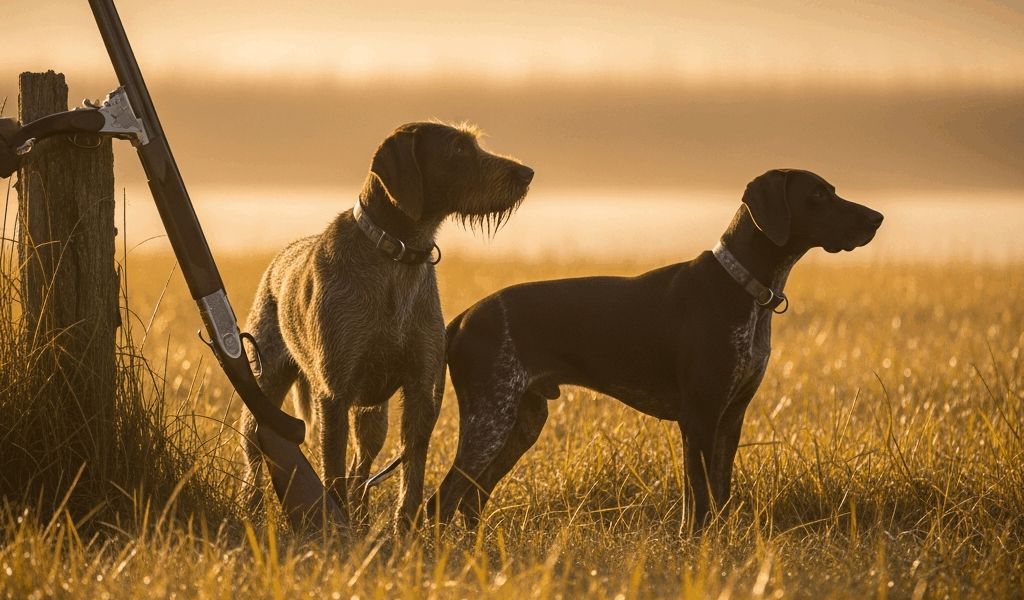
Wirehaired Pointing Griffon vs German Shorthaired Pointer for Hunting
Range and Temperament Are the Real Differences — Everything Else Is Noise
Choosing between a wirehaired pointing griffon vs German shorthaired pointer has gotten complicated with all the forum arguments and breed-loyalty tribalism flying around. So let me cut through it. As someone who’s owned griffons for eleven years and hunted alongside GSP handlers for just as long, I learned everything there is to know about what actually separates these two dogs in the field — and it’s not what most comparison articles lead with.
My current dog is a four-year-old male named Soot. Before him, a female named Rue who made it to fourteen. My hunting partner Dave has run shorthairs exclusively since 2009 — his current dog is a four-year-old named Flint — so I’ve had a front-row seat to both breeds working real birds in real conditions more times than I can count.
Here’s the verdict: the GSP covers more ground, moves faster, and works independently. The WPG hunts closer, has a softer temperament, and stays locked onto its handler. Big open fields and a dog that pushes hard to the edges? Get the shorthair. Mixed cover on foot, a dog that checks in, and a genuinely calm house companion? Get the griffon. That’s the whole article compressed into two sentences. But the details matter — so let’s get into them.
Hunting Style Comparison
Range and Ground Coverage
Watching Dave’s dog Flint work open prairie is honestly something else. He quarters out to 150 yards on a calm day without hesitation — long, looping casts, and he does it fast. If you’re hunting from horseback or covering large CRP tracts where the dog needs to find birds before you arrive, that range is a genuine asset. That’s what makes the shorthair endearing to us big-field hunters who’ve worked those wide-open quail and pheasant grounds.
Soot works 40 to 60 yards out on average. Sometimes closer. In heavy pheasant cover along a creek bottom — cattails, willow tangles, the kind of stuff that swallows a dog whole — that’s not a limitation. It’s exactly what I want. Eduard Korthals didn’t design this dog to win field trial casts. He was frustrated by versatile hunting dogs that lost contact in dense cover, so he developed the griffon specifically for the meat hunter on foot, using a methodical close-working style as the whole foundation. This new approach took off several years later and eventually evolved into the breed enthusiasts know and hunt behind today.
Water Work
This is where griffons separate themselves pretty clearly. Soot hits 45-degree water in October without a second thought. The wire coat, the dense undercoat, the webbed feet — the griffon is structurally built for cold-water retrieval in a way shorthairs simply aren’t. GSPs retrieve from water willingly enough, but a short coat in cold water is just a short coat in cold water. On duck hunts where I’m also hunting upland, Soot handles both jobs without complaint. I’ve watched GSPs quit cold retrieves after a few birds. I’ve never seen Soot quit. Not once.
The GSP has nothing to apologize for in water — they’re capable retrievers. The griffon is just better suited for it physically. Don’t let anyone tell you otherwise.
Pointing Intensity and Style
Both breeds are pointing dogs. Both lock up hard on birds. But what is the stylistic difference, really? In essence, it’s posture and energy — the GSP points with head high, tail straight or flagged, the full athletic silhouette of a fast dog that skidded to a stop. The griffon points with the same intensity but lower head carriage and a slightly more crouched posture. But it’s much more than an aesthetic thing. That lower head carriage on the griffon seems to genuinely help track moving birds through dense cover. Some hunters prefer the GSP’s dramatic style. I prefer functional.
Neither breed flushes wild consistently with proper training. Both will back other dogs. If you want a pointing dog, both breeds deliver — the context and range are just different.
Temperament Off the Field
Probably should have opened with this section, honestly. For anyone with kids or a partner who didn’t sign up for a high-octane working dog in the living room, the off-field temperament question matters more than any hunting comparison.
The Wirehaired Pointing Griffon at Home
Griffons are velcro dogs. Not a metaphor. Soot is physically beside me or on me most of the time I’m home — follows me room to room, sleeps against my legs, greets strangers with real enthusiasm but not the frenetic bouncing-off-walls energy that knocks kids over. He’s calm indoors in a way that genuinely surprises people who expect a hunting dog to be a menace in the house.
The flip side of that closeness is real, though. Griffons don’t do well with isolation. Long hours alone in a kennel or yard will wear on them. Rue — my first griffon — developed some destructive habits when I went through a stretch of brutal work weeks without giving her enough attention. Don’t make my mistake. I eventually started either bringing her to work or having a dog walker come by midday. Griffons need their people, full stop.
Training a griffon requires a soft hand. Not a passive hand — they need clear structure — but heavy corrections backfire hard. My Garmin Pro 550 Plus is set around 8 to 12 with Soot, and that’s only for critical safety commands. I’ve watched GSP trainers use stimulation levels that would shut a griffon down completely for the rest of the day. Know that before you start.
The German Shorthaired Pointer at Home
Dave’s GSPs are genuinely good dogs. They’re also a lot of dog, all the time. Flint is four years old and still runs the backyard fence line for an hour after returning from a full day’s hunt. He needs hard daily exercise to be manageable indoors — a serious 45-minute run, not a casual loop around the block. When Dave travels for work and the routine breaks down, Flint starts eating things. Furniture. Drywall. Dave’s words, not mine.
GSPs can be wonderful family dogs — but they match best with active families. Kids who are athletes, households that run and bike and hike. In a lower-activity home, that energy needs somewhere to go or it becomes a genuine problem. They’re also more independent by temperament, which means less likely to follow you around the house, and less likely to look to you for direction when something confuses them in the field.
For a first-time bird dog owner, the griffon’s handler focus is a real advantage. The dog actually wants to work with you — and that makes the whole training relationship easier to build from the ground up.
Health and Longevity
Hip Dysplasia and Orthopedic Issues
Both breeds carry hip dysplasia risk. OFA data puts WPGs with fair or poor hip ratings at roughly 10 to 12 percent historically — better than a lot of sporting breeds, but not nothing. GSPs come in similarly, around 11 to 14 percent depending on the year. Buy from breeders who OFA certify both parents. That’s not optional. Ask to see the actual certificates — if a breeder hedges on that request, walk away immediately.
Griffons also carry a hereditary condition called cerebellar cortical degeneration — a serious neurological disease the GSP doesn’t share. Responsible breeders test using the available genetic panel. Ask specifically whether both parents were tested and cleared. This is a griffon-specific issue and it matters.
Lifespan
Rue made it to fourteen, which is on the longer end but not unheard of. WPGs typically run 12 to 15 years. GSPs tend toward 12 to 14. Close enough that lifespan shouldn’t be a deciding factor between the two. Individual longevity has more to do with weight management, joint health, and how hard you work them late in life than with any breed average.
Grooming — Wire Coat vs Short Coat
This is a real practical difference that gets glossed over constantly. The GSP’s short coat is genuinely low maintenance — wipe it down, done. The griffon’s wire coat needs hand stripping or professional grooming two to three times per year to stay in proper condition. It also catches burrs, seeds, and debris constantly through hunting season. After every hunt, I spend fifteen minutes going through Soot’s beard, legs, and ears with a Safari wide-tooth comb and an Oster slicker brush before we get in the truck. It becomes routine — but it is time and it is cost. A full strip and tidy at a groomer runs me $90 to $120 depending on the shop.
The wire coat’s advantage is functional, though. It protects the dog in heavy cover in a way a short coat simply can’t. Soot has pushed through multiflora rose tangles that would have shredded an unprotected dog. The coat earns its maintenance.
Ear health matters for both breeds — floppy ears trap moisture and both breeds pay the price. Check and clean weekly, especially after water work. My vet recommended Oti-Clens years ago and I’ve used it ever since. Ear infections are the most common health headache I see among hunters who skip that routine. Both breeds, every time.
Which One Is Right for You
Burned too many times by vague “it depends on your lifestyle” answers in breed comparison articles, I’m going to be direct. These are my actual recommendations by use case.
Get the Wirehaired Pointing Griffon If
- You hunt primarily on foot through mixed or heavy cover
- You do waterfowl hunting alongside upland work and want one dog handling both
- You’re a first-time bird dog owner who wants a dog that naturally works with you
- You have kids and need a dog that’s genuinely calm in the house
- You hunt in tight quarters — small hunting parties, walk-up pheasant, grouse in the woods
- You have the time and patience for a wire coat grooming routine
Get the German Shorthaired Pointer If
- You hunt big open ground — prairie, large agricultural fields, wide-open quail country
- You want maximum ground coverage and can handle a dog that works at real distance
- You’re an experienced trainer comfortable with a more independent dog
- Your household runs high energy and you want a dog that matches that pace
- You compete in hunt tests or field trials where range and style are evaluated
- Low-maintenance coat care is genuinely a priority for you
The Honest Bottom Line
Both dogs are outstanding hunting companions. I’m not going to pretend the GSP is a lesser dog — it isn’t. Flint has made me genuinely jealous on days when birds were spread wide and Dave was putting up double the flushes I was getting. That range is a real asset in the right situation.
But I keep coming back to griffons. The close work. The way Soot looks back at me in heavy cover — checks in, adjusts his pattern to where I’m going. The October duck retrieve from water that would make a lesser dog quit. The fact that he’s asleep on my feet right now while I write this. He’s a hunting dog that actually lives like a family member, and apparently that combination is harder to find than most people think before they go looking for it.
Driven by years of watching both breeds work real birds, I’d tell any walk-up bird hunter or combination upland-and-waterfowl hunter to seriously consider the griffon first. The GSP might be the better option for open-country specialists, as that style of hunting requires range and independence — that is because birds are spread wide, the ground is fast, and you need a dog that covers it without waiting to be directed. But for the way most hunters actually hunt — on foot, in mixed cover, wanting a dog that’s manageable at home and checks in in the field — the WPG is the more practical choice. It’s underrated relative to how often the GSP gets recommended by default.
Either way — buy from health-tested parents. Hunt your dog. And don’t skip the ear cleaning.

Stay in the loop
Get the latest griffist updates delivered to your inbox.