Two Wire Coats, One Big Decision — WPG vs GWP for the Serious Hunter
I’ve hunted behind both breeds for the better part of a decade — owned griffons, trained alongside GWP handlers in NAVHDA chapters across the Midwest. My griffon, a male named Birch, has been my primary hunting dog for six seasons now. My training partner Steve runs a GWP named Hank out of the same kennel club. Between the two of us, we have logged hundreds of hours watching these breeds work real cover, real birds, real conditions.
Quick version: the GWP covers more ground, hunts harder, and makes decisions on its own. The WPG works closer, checks in constantly, and genuinely wants to hunt with you rather than for you. Big prairie fields with a horseback hunter? GWP. Thick creek-bottom pheasant cover on foot with your buddies? WPG. That distinction should drive about 80 percent of the decision for any serious bird hunter.
Temperament Is the Real Difference — Everything Else Follows From It
Once you understand the temperament gap, every other difference between these breeds makes intuitive sense.
The WPG is a people-oriented dog. Birch follows me from room to room in the house, sleeps against my leg, greets strangers with tail-wagging enthusiasm that borders on embarrassing. In the field, he looks back at me while he hunts — actually checks in, adjusts his pattern to where I am walking. That connection is what makes training a griffon manageable for a first-time gun dog owner. I keep my Garmin at level 6 with Birch, and honestly I rarely touch it.
The GWP is more independent. Steve’s dog Hank is confident, intelligent, and somewhat self-directed in the field. Not stubbornness in the negative sense — it is the expression of a dog bred to make decisions at range without constant handler input. In experienced hands this produces a remarkable hunting partner. In less experienced hands it can produce a dog that does what it wants, when it wants. Hank also has a higher prey drive that shows up at home — more likely to chase the barn cats, squirrels, anything that moves. Steve has learned to manage that. A first-time owner might not.
As family dogs, both are affectionate and loyal. The WPG’s gentler energy tends to make it a better fit in households with young children. The GWP can do well with families but requires more vigorous daily exercise to stay settled — a bored GWP is a destructive one, and Steve has the chewed baseboards to prove it.
Hunting Style — Range, Drive, and Where Each Dog Belongs
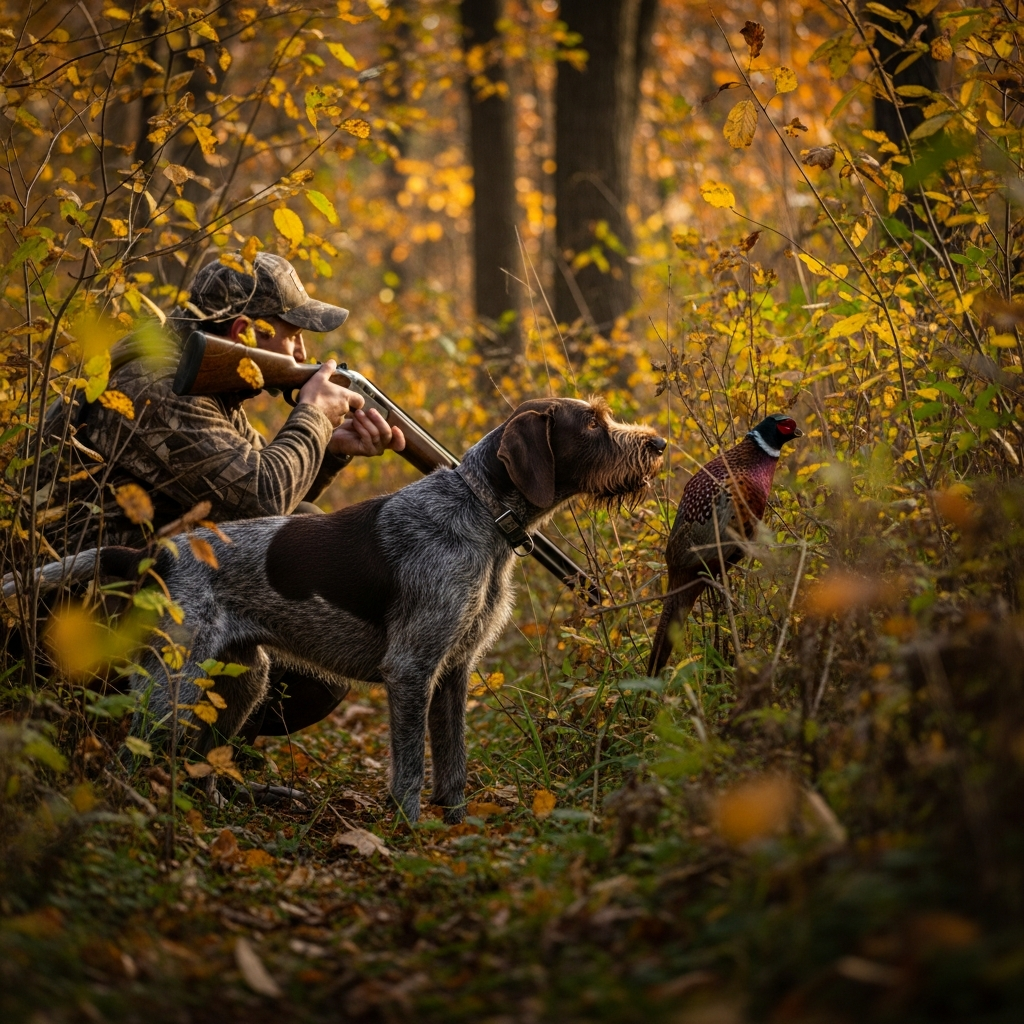
Both are legitimate all-season versatile hunters — they point, track, retrieve from land and water, and can take game from grouse to pheasant to ducks. The difference is how they go about it.
Birch hunts at a moderate pace, typically 30 to 50 yards out, and is exceptionally good in heavy cover — thick brush, cattail marshes, dense timber edges. Eduard Korthals was working with versatile hunting dogs that kept losing contact in dense European cover, so he built the griffon specifically for the meat hunter on foot, emphasizing a methodical close-working style from the start. For pheasant in thick CRP grass, woodcock in alder runs, or waterfowl in cold marshes, the WPG is purpose-built.
The GWP covers more ground at a faster pace. Hank will push out to 100 yards on open prairie without thinking twice. That suits grasslands, large rolling fields, wide-open upland bird country — where his range is an asset rather than a problem. The GWP is also an excellent blood tracker for big game, which Steve values during deer season.
In water, both retrieve willingly from cold water, but the WPG has a genuine edge in dedicated waterfowl work. Birch’s dense double coat and webbed feet carry him into 40-degree October water without hesitation. I have watched him do late-season retrieves that would make a thinner-coated dog quit.
Trainability — Be Honest About Your Experience Level
The WPG is commonly described as one of the most trainable versatile hunting breeds. Accurate — but trainable does not mean self-training. It means the dog is responsive, willing, and forgiving of beginner mistakes. A first-time gun dog owner who commits to training, does their homework on NAVHDA methods, and puts in consistent work during the first two years will get a very solid hunting dog from a quality WPG. Natural biddability doesn’t replace structured training, but it makes the process less punishing when you inevitably time a correction wrong.
The GWP needs an experienced handler. Not because it is difficult in a negative sense, but because its higher drive and independent nature require someone who can stay ahead of it. Steve had trained two pointing breeds before Hank and still found the first year demanding.
Both breeds mature more slowly than some — expect 18 to 24 months before either dog is fully developed and settled in the field.
Health, Lifespan, and What to Ask the Breeder
Both breeds have similar lifespans — 12 to 14 years is typical for healthy, well-bred individuals from tested parents.
For the WPG, the primary health concerns are hip dysplasia, elbow dysplasia, and progressive retinal atrophy. Any reputable WPG breeder should provide OFA hip and elbow certifications and a CAER eye clearance before breeding. Ask for these documents, not just verbal assurances.
For the GWP, hip dysplasia is also the primary orthopedic concern, along with a higher predisposition to bloat compared to the WPG. Bloat is a life-threatening emergency — know the signs: distended belly, unsuccessful attempts to vomit, restlessness after eating. Some GWP owners elect prophylactic gastropexy at the time of spay or neuter.
Both breeds should have OFA and eye testing from breeders. Ask specifically about health testing on both parents, not just the sire. If a breeder hedges on producing certificates, walk away.
Which Dog Should You Actually Get
Both breeds are genuinely excellent, and the right answer depends entirely on how and where you hunt.
Get a Wirehaired Pointing Griffon if you are:
- A dedicated amateur hunter who wants a cooperative, close-working partner
- Hunting primarily pheasant, woodcock, waterfowl, or mixed cover species
- A first-time gun dog owner committed to proper training methods
- Hunting with a group where a wide-ranging dog would be a liability
- Looking for a dog that transitions easily between working dog and gentle house companion
Get a German Wirehaired Pointer if you are:
- An experienced gun dog trainer who has managed high-drive dogs before
- Hunting primarily in open terrain — upland birds in large fields or prairie
- Looking for a dog with maximum range and speed in the field
- Multi-species hunting including big game tracking, where GWP versatility shines
- Committed to the significant daily exercise requirement this breed demands
Both dogs, from reputable breeders with tested working dogs in the pedigree, will be outstanding hunting companions in the right situation. Do your homework on breeders — health testing and field performance in the breeding stock matter enormously for both.

Stay in the loop
Get the latest griffist updates delivered to your inbox.