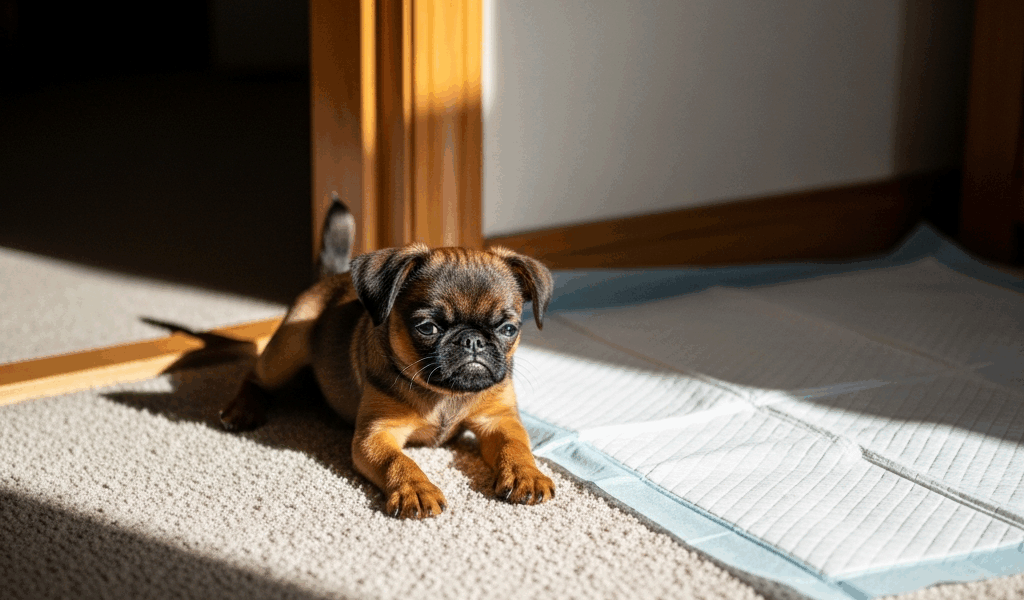
Why Brussels Griffons Are Hard to Potty Train
Brussels Griffon potty training has gotten complicated with all the generic dog advice flying around. As someone who spent six months wrestling a Griffon puppy named Biscuit into something resembling a house-trained dog, I learned everything there is to know about this breed’s particular brand of stubbornness. Today, I will share it all with you.
But what is a Brussels Griffon, really, from a training standpoint? In essence, it’s a four-to-ten-pound companion dog with the bladder of a grape and the temperament of a minor Belgian aristocrat. But it’s much more than that. The wiring is genuinely different from a Golden Retriever or a Lab — and most online training guides don’t acknowledge that at all.
Start with the bladder situation. A Griffon puppy can physically hold urine for maybe one to two hours. A Lab puppy might manage three. This isn’t laziness or defiance. It’s anatomy. A grape-sized bladder fills fast. That’s just the reality you’re working with.
Then there’s the stubbornness — and honestly, “stubbornness” undersells it. These dogs were bred as apartment companions for Belgian aristocrats, not as eager-to-please working dogs. They view you as their property. When a Griffon decides the backyard is too wet, too cold, or simply beneath their current emotional state, they will hold that position with startling conviction. No signal. No warning. Just a 2 a.m. surprise on your bedroom rug.
Weather sensitivity makes everything worse. Griffons have minimal coat coverage on their bellies and legs — rain feels like a personal betrayal to them. Anything below 45°F and forget about lingering outside. I watched Biscuit step onto the porch during a December drizzle, freeze in place like a tiny furry statue, and march back inside after twelve seconds flat. She peed on the kitchen tile twenty minutes later. That was December 2022. It happened six more times that month.
Attachment anxiety rounds out the picture. Griffons are bred to shadow their person everywhere. Sending a Griffon puppy outside alone while you watch from the window creates genuine distress for some of them. They’d rather sprint back to you than spend thirty seconds in an unfamiliar sensory environment without backup.
Knowing all this doesn’t solve the problem. But it stops you from assuming you’re doing something wrong when you’re actually just dealing with a Griffon.
The Most Common Potty Training Mistakes Griffon Owners Make
Probably should have opened with this section, honestly. The mistake I see repeated across every Brussels Griffon Facebook group is inconsistent scheduling. An owner takes their puppy out every hour on Monday. Life happens Tuesday. Suddenly they’re going every three hours. Griffons don’t adapt to unpredictability — they collapse under it. Break the ritual, and their bladder control breaks with it.
Mistake two: waiting for an obvious signal. Many owners expect their Griffon to sit at the door or bark. Some do. Most don’t. Instead they circle. They sniff the baseboards. They stare at you with those bug eyes like you’re supposed to just know. These are signals — just subtle ones. Miss them — and you will, because you’re checking your phone — and the puppy squats wherever they’re standing. Window closed.
Pee pad training followed by an outdoor transition is another disaster I’ve seen play out repeatedly. I’m apparently someone who tried pads for three weeks before abandoning them, and the confusion it created took two months to undo. Griffons are literal thinkers. Absorbent surface equals toilet, full stop. Once that association is established indoors, undoing it takes twice as long as skipping pads entirely would have. Don’t make my mistake.
Leaving a young Griffon alone too long is guaranteed failure — not a training failure, a logistics failure. A puppy under four months old cannot hold it past two hours. If you work a 9-to-5 without a midday break or dog walker, you’re setting everyone up. The accidents that follow aren’t disobedience. They’re physics.
Finally: crate sizing. Owners buy oversized crates thinking their tiny Griffon will grow into a 30-inch kennel. Bad idea. An oversized crate means the dog pees in one corner and sleeps in the other — the whole housetraining logic collapses. The crate should be snug. For an adult Griffon, that means roughly 24 inches long and 17 inches tall. Just enough to turn around and lie down. That’s it.
How to Build a Schedule That Works for This Breed
So, without further ado, let’s dive in. Here’s the schedule that actually worked for Biscuit — built through trial, error, and a lot of paper towels:
- 8 weeks to 4 months: Outside every 1-2 hours during waking time, always after meals, naps, and play sessions
- 4 months to 6 months: Every 2-3 hours during the day, before bed, after meals
- 6 months to 12 months: Morning, midday, evening, before bed — four times daily minimum
- 12+ months: Most Griffons stabilize at three to four times daily, though some stay unpredictable until 18 months
Your non-negotiable anchor points: immediately after waking, 15 minutes after eating, after any play session, and right before bed. Miss those windows consistently and nothing else you do will compensate.
If you work outside the home, you need a midday solution — dog walker, neighbor, daycare — until your Griffon hits at least six months old. Not optional. An eight-week puppy alone from 8 a.m. to 5 p.m. will have accidents. Every time. The math doesn’t work otherwise.
Work-from-home owners have a real advantage here. Just don’t waste it by letting the dog out randomly whenever you feel like it. Set specific times. Routine builds understanding — that’s what makes a predictable schedule so endearing to us Griffon owners who’ve tried everything else first.
What to Do When Your Griffon Refuses to Go Outside
This is where Griffon ownership gets real. Your schedule is tight. Your training is solid. And your dog stands at the door, clocks the light drizzle outside, and pivots back toward the couch without a single apology.
Rain refusal is the most common scenario. First, you should get a lightweight dog raincoat — at least if you live anywhere with actual weather. The Tooth & Honey models run about $18-25 on Amazon and fit Griffons well. More importantly, create a covered potty spot near your door. A $30 patio umbrella staked into the ground nearby gives your Griffon the psychological permission to step outside. You’re not changing the weather. You’re removing the sensory assault.
Cold resistance requires high-value treats used exclusively outdoors. Small pieces of plain boiled chicken or sharp cheddar — nothing they get inside, ever. The second they go outside in cold weather, the treat appears. Immediately. Repeat this process thirty times over two weeks. The dog starts associating outside with jackpot, not punishment. It works. Biscuit eventually started trotting outside in 38°F weather like it was nothing — purely for the chicken.
The freezing dog — the one who steps outside and just locks up — often responds to a designated potty spot. Pick a specific corner of your yard. Take them to that exact spot every single time. Within a week or two, their brain files it: go here, do the thing, good things happen. Griffons like ritual. Use that.
Belly bands might be the best option as a short-term management tool, as Griffon training requires time and repetition. That is because even well-trained Griffons can have setbacks during high-distraction periods — guests, travel, schedule changes. Use belly bands during car rides or when company’s over. Just don’t use them as a substitute for actual outdoor training. They prevent accidents. They don’t teach anything.
Signs Your Griffon Is Making Progress and When to Ask the Vet
Progress with Griffons looks quieter than with other breeds. There’s no dramatic “runs to the door and barks” moment for most of them. Instead, watch for fewer indoor accidents overall, longer dry stretches, and the dog occasionally drifting toward you before they need to go — subtle, easy to miss, but real.
Most Griffons aren’t reliably housetrained until somewhere between 6 and 8 months old. Some take until 12 months. That’s normal for this breed. Patience isn’t optional — it’s the whole game.
While you won’t need a complete veterinary workup for every accident, you will need a handful of red flags in your head. If your Griffon is having accidents despite a solid, consistent routine, book a vet visit. UTIs are common in small dogs and cause urgent, frequent urination that training cannot fix. Bladder stones and diabetes present similarly. Anxiety disorders can also trigger accidents — your vet can discuss behavioral support or medication if that’s what’s going on.
A full week without indoor accidents is real progress. Celebrate it. Then brace yourself, because the following week might include a relapse. That’s Griffons. That’s just what they are — and somehow, that’s also what makes them endearing to us Griffon people who keep choosing them anyway.

Stay in the loop
Get the latest griffist updates delivered to your inbox.