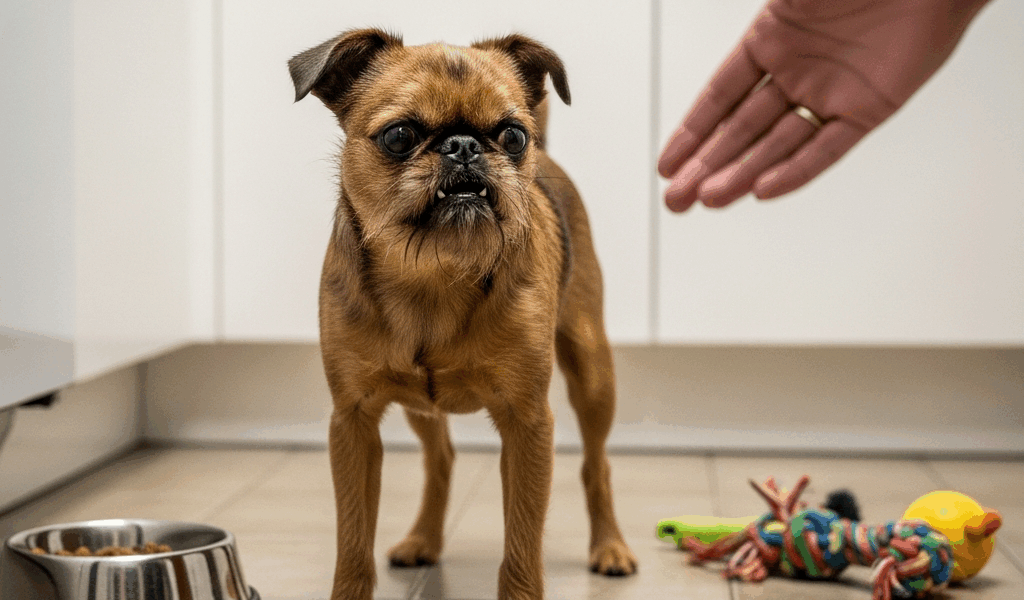
Why Brussels Griffons Get Aggressive
Brussels Griffon aggression has gotten complicated with all the conflicting advice flying around. And most owners aren’t searching for that advice calmly — they’re typing it in at 10 p.m. on a Tuesday after their dog just snapped at someone, heart still going a little fast.
As someone who’s worked with Brussels Griffons for over a decade, I learned everything there is to know about what actually drives this breed to react. Today, I’ll share it all with you. The short version first: these dogs don’t wake up mean. What they wake up with is sensitivity — high, almost exhausting sensitivity. Every shift in body language registers. Every unexpected hand movement. Every stranger’s tone. They also bond intensely, usually to one specific person, and stay genuinely suspicious of everyone else. Pack that combination into a 10-pound body with a big-dog attitude and you get a dog with a very low threshold for handling.
But what is a “triggered response” versus an aggression problem? In essence, it’s the difference between a dog reacting to something specific and a dog that’s broadly dangerous. But it’s much more than that — because once you identify the trigger, you’ve already halfway solved the problem. That’s what makes this breed endearing to us Griffon people, honestly. There’s usually a reason. Find it, and you’ve got something to work with.
Punishing a Brussels Griffon for snapping without understanding why is like turning off a check engine light without opening the hood. The warning goes silent. The problem doesn’t.
The Most Common Aggression Triggers in Griffons
Probably should have opened with this section, honestly. These are the five situations where Griffon owners most often watch their dog flip a switch:
- Unexpected handling or being picked up — A hand dropping down fast, a child grabbing them from the side, someone scooping them up mid-stride. This breed needs to see it coming. Every time.
- Resource guarding — Food, toys, their favorite human. A Brussels Griffon defending these things will genuinely surprise owners who’ve only had larger, more laid-back breeds.
- Stranger approach — Doorbell, someone stepping inside, a neighbor stopping by the fence. They announce themselves loudly first. If the perceived threat doesn’t retreat, things escalate.
- Other dogs in close quarters — Dog parks, sidewalk passes, tight spaces on walks. Their small size produces overconfidence rather than caution. Every time.
- Overstimulation during play — Griffons wind up fast. Play goes long or intense, and instead of self-regulating, they snap. The switch flips.
If your dog snapped or growled, one of these five things happened first. Usually within seconds.
How to Tell Real Aggression from Grumpy Noise
Brussels Griffons are vocal dogs. They growl, they grumble, they make noises that sound genuinely alarming — and usually aren’t. This matters more than most owners realize, because responding wrong to a warning growl can manufacture real aggression where only anxiety existed before.
A warning growl is communication. Legitimate, valuable communication. It’s the dog saying “back off, I’m uncomfortable.” That signal is something you can actually work with.
Real escalation looks different. Full-mouth bites without prior warning. Lunging from across a room. Sustained snapping rather than a single snap-and-retreat. Aggression appearing in situations where the dog previously showed zero reaction. Those patterns point either to a medical issue — especially if the onset was sudden — or a trigger that’s been ignored long enough to become a learned response.
The biggest mistake I’ve seen repeated: owners punishing the growl to make it stop. That removes the signal. It does nothing about the discomfort driving it. Now the dog skips the warning and goes straight to contact. Don’t make my mistake — I corrected a growl early in my career and the dog bit me clean three days later with no warning at all. Lesson learned the hard way.
Respect the growl. It’s telling you exactly where the line is.
Step-by-Step Fixes for Each Trigger
Handling Aggression — Desensitization with Treats
Start by getting specific. Is it being picked up? Paw handling? Collar grabs? The specificity matters — “he doesn’t like being touched” is too vague to train against.
For a dog that snaps when picked up, find the distance or position where they’re still calm and start there. You’ll need high-value treats — I’m apparently freeze-dried chicken obsessed, and Primal’s 5.5-ounce bag ($18 at most pet supply stores) works for me while soft training treats never really landed with the Griffons I’ve worked with. Toss a treat, then move your hand toward their torso as if you’re about to pick them up. Stop short. Treat again. Ten repetitions daily, one full week. No actual lifting yet.
Week two: hand moves closer, touches their torso briefly, you immediately pull back and treat. Still no lift.
Week three: same motion, but you lift them one inch off the ground for a single second. Set them down, treat immediately. Most owners see real progress within three to four weeks. The rule is simple — never move faster than the dog can track with their eyes. A snap during this process means you’ve moved too fast. Back up a step.
Resource Guarding — The Trade-Up Protocol
First, feed your Brussels Griffon separately from other pets. Full stop. If food guarding is the issue, begin hand-feeding their regular kibble one piece at a time. You’re resetting what your hand approaching the bowl means to them.
Once hand-feeding feels relaxed — usually takes two to three weeks — start the trade-up. Bowl goes down. While they eat, approach slowly with something higher value — a small cube of chicken or a piece of cheese. Drop it into the bowl. Walk away. You’re not taking anything. You’re adding something. You’re teaching them that your approach predicts better things arriving, not resources disappearing.
Run this daily for a full month before you ever practice actual bowl removal. That sequence matters.
Stranger Reactivity — Threshold Distance Work
A Brussels Griffon reacting to strangers is almost always reacting from too close. Back up — literally.
Find a friend or family member willing to help. Have them stand at whatever distance your dog notices them without growling. Maybe 15 feet. Maybe 20. That’s your starting threshold. Reward calm behavior. The stranger does nothing — no eye contact, no movement, no talking. They’re just a boring, non-threatening object in the environment.
Over two to three weeks of daily practice, that distance shrinks naturally as the dog’s comfort grows. The stranger becomes less of a threat because they’ve proven, repeatedly, to be completely uninteresting. That’s the whole mechanism. So, without further ado — boring strangers are your best training tool.
When the Aggression Needs a Vet or Trainer
Stop here if your Brussels Griffon has never shown aggression before and suddenly starts. Schedule a vet appointment — not next week, soon. Sudden-onset aggression in an adult dog frequently points to pain, thyroid dysfunction, or neurological changes. A behavioral protocol built on top of an undiagnosed medical issue won’t hold.
Also consult a veterinary behaviorist — not just a trainer — if any of these apply:
- The dog has bitten someone and broken skin
- The aggression escalates despite consistent training over several weeks
- Biting happens with zero warning signals beforehand
A local trainer can’t diagnose a medical cause. A general practice vet isn’t trained in behavioral rehabilitation. A board-certified veterinary behaviorist covers both — and for serious cases, that gap matters.
DIY protocols work for triggered reactivity. They don’t work for dogs with underlying medical problems or severe behavioral histories. Knowing which situation you’re actually in might be the most important call you make.

Stay in the loop
Get the latest griffist updates delivered to your inbox.