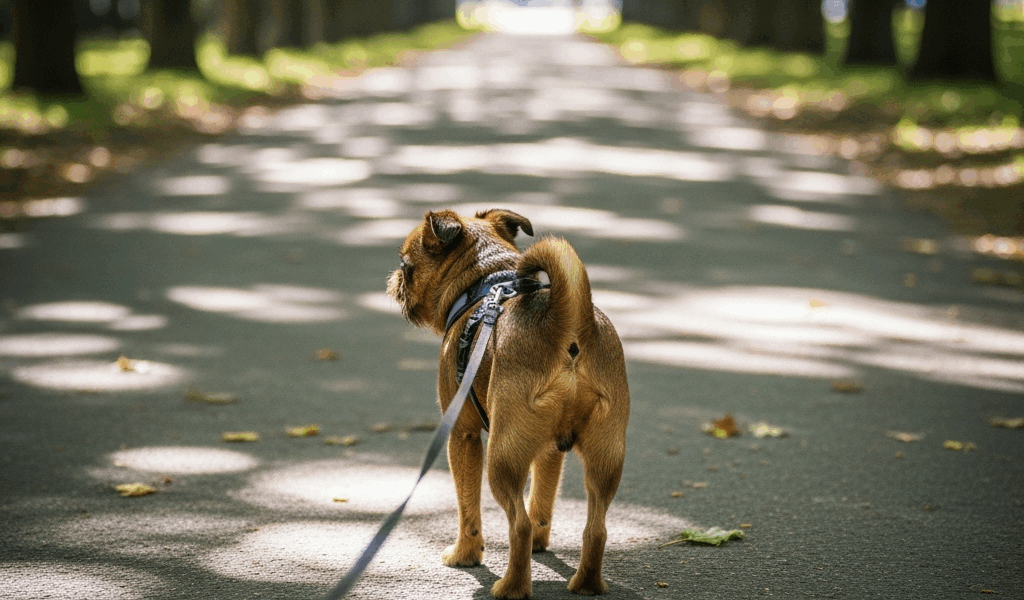
Why Brussels Griffons Pull More Than Other Small Dogs
Brussels griffon leash training has gotten complicated with all the generic small-dog advice flying around. Most of it was never written with this breed in mind — and it shows.
As someone who has worked with dozens of Griffon owners over the years, I learned everything there is to know about why these dogs behave the way they do on leash. Today, I will share it all with you.
Nearly every owner tells me the same thing: “The methods that worked for my friend’s Cavalier did absolutely nothing.” That’s not a training failure. That’s breed architecture doing exactly what it was designed to do.
But what is a Brussels Griffon, really? In essence, it’s a ratter and lap dog hybrid developed in 1800s Brussels. But it’s much more than that. These dogs hunted vermin in tight, unforgiving spaces — solo work that hardened an independent streak into something almost philosophical. They also carry prey drive that is frankly disproportionate to their size. That squirrel across the street isn’t a distraction to a Griffon. It’s an assignment.
Here’s the physical reality nobody mentions: these dogs weigh 8 to 10 pounds and are built like small tanks. Dense neck. Compact shoulders. When a Griffon decides to move toward something, the force surprises people every time. I’ve watched owners brace for a gentle tug and get lurched forward instead. That was not a fluke. That’s just a Griffon being a Griffon.
Standard loose-leash training assumes food motivation and a dog that respects gentle guidance. Griffons are food-motivated when they feel like it — which is not always when you need them to be. The same independence that made them effective hunters works directly against conventional obedience frameworks. Add in a temperament that genuinely does not believe it is ever wrong, and you have a dog that will outlast your patience with standard methods every single time. That’s what makes the Griffon so endearing to us small-dog people, honestly — and also what makes leash training require a completely different approach.
The Gear Problem Most Owners Miss
Probably should have opened with this section, honestly. Equipment choices will either cut your problem in half or quietly make everything worse.
Most small-dog owners reach for a collar by default. Cheap, traditional, widely available. For a Brussels Griffon, it’s almost guaranteed to fail — and it carries a real physical risk most people don’t know about until something goes wrong.
Brussels Griffons are brachycephalic. Flat face, compressed airway, breathing that’s already working harder than it looks. Collar pressure — even the gentle kind — compresses a trachea that has very little margin to spare. The results sound alarming: coughing, gagging, that horrible reverse-sneeze that makes new owners think their dog is choking. They’re not choking. They’re experiencing tracheal stress. Repeated over weeks and months, that stress causes real inflammation and makes ordinary walks harder to breathe through. Don’t make my mistake of assuming a small correction is harmless just because the dog is small.
The fix is a front-clip harness. Full stop.
A front-clip harness attaches at the chest, not the neck. Mechanically, when your Griffon leans into the leash, the harness rotates their body toward you instead of letting them power forward. No choking involved. No correction involved. Just physics. A 10-pound dog pulling against a chest-attachment point gets gently redirected — every single time, automatically, without any effort from you.
The Freedom No-Pull Harness runs about $25–$35. The Easy Walk Harness comes in around $20–$28. Both accomplish the same basic thing. Fit matters more than brand — two fingers should slide under the straps without forcing it. I’m apparently a Freedom No-Pull person and that harness works for me while the Easy Walk never quite sits right on the barrel-chested Griffons I’ve worked with. Your dog may differ.
Avoid the tiny vest-style chest harnesses. They restrict shoulder movement and compress the chest — exactly wrong for a brachycephalic dog that needs room to breathe and move normally.
The Stop-and-Wait Method Step by Step
This is the core technique. It’s not fast. Your Griffon will test your patience with it in ways that feel personal. But it works — and it works specifically because it doesn’t ask your dog to respect your authority. It just removes the reward for pulling.
- Start on a quiet street. A residential block with minimal squirrel traffic, no dog park nearby, light foot traffic. Your Griffon needs low distraction for the first several sessions. Week one is not the time for the busy commercial strip.
- Wait for the pull. Walk normally. The second your dog leans into the leash — toward anything — stop walking immediately. Freeze completely. No verbal correction. No leash tug. Nothing.
- Stand still until the leash goes slack. This is where owners struggle most. You just wait. Your Griffon will stand there looking confused. Some will test the leash again. You stay frozen. Patience is literally the only tool at this step — there’s nothing else to do.
- Mark the slack the instant it happens. Say “Yes” clearly, or click if you use a clicker. Follow immediately with a high-value treat. Small piece of chicken, hot dog, or cheese. Not kibble. Real food. The timing here matters more than people realize — you have about one second to connect the marker to the behavior.
- Resume walking. Take three to five steps and let the sequence repeat. You are not trying to cover distance. You are teaching a mechanism. A successful 15-minute session might cover half a block. That’s fine.
- Expect the plateau around day three or four. Most Griffons figure out that pulling makes you stop — so they pull, pause, then pull again immediately after you restart. This is your dog testing the system with the full weight of their intelligence. Hold the line. This phase lasts days to weeks. Your Griffon is stubborn. You are stubborn now too.
Realistic timeline: two to three weeks of consistent daily practice before pulling decreases noticeably. Some Griffons take longer. This is not a quick fix — but it tends to be a permanent one, because you’re not suppressing a behavior through punishment. You’re making it pointless.
When Your Griffon Refuses to Move at All
Separate problem. Completely different energy from pulling, and it catches owners off guard.
At some point — usually around the same time pulling starts decreasing — many Griffons simply stop. They plant themselves on the sidewalk like a piece of furniture. Not hurt. Not frightened. Just done. They won’t go forward. They won’t go back. They are making a deliberate choice and they would like you to acknowledge it.
This is the Griffon version of negotiation. Pulling didn’t work. Now they’re testing whether standing still will. The question they’re asking is: will you drag me?
The answer is no. Dragging a Griffon forward damages the trust you’ve spent weeks building — and puts pressure on a trachea that still can’t afford it, even with a harness.
Instead, change direction entirely. Don’t pull forward. Turn 90 degrees and walk the opposite way, moving slightly faster than your normal pace. Most Griffons will follow within a few seconds — movement in a new direction is interesting, and interesting beats stubborn about 70% of the time. The moment they move with you, praise immediately and hand over a treat. You’ve made following you more rewarding than standing still.
Liverwurst held just in front of the nose is more persuasive than any leash pressure you will ever apply. Use luring freely. There’s no shame in it.
Some owners find that three 10-minute sessions work better than one 30-minute walk. Griffons disengage around the 15-minute mark — attention just drops off. Shorter sessions mean you end on success instead of mutual frustration, which matters more than it sounds like it does.
Signs the Training Is Working and What to Do Next
Progress with a Griffon is quiet. There’s no dramatic overnight shift. Watch for smaller things instead.
Your dog takes slightly longer to pull at the start of a walk. The pull feels lighter when it does happen. Their attention returns to you faster after a distraction. You complete a full block with three stops instead of fourteen. That’s progress. Real progress. Write it down if you need to — it helps on the days it doesn’t feel like anything is working.
Once quiet-street walks are reliable, introduce distraction gradually. Walk past the dog park perimeter. Try a busier neighborhood block. Change the time of day. Each new environment resets the learning slightly — that’s normal, not a setback. The foundation holds if consistency holds.
This new approach takes hold over several weeks and eventually evolves into the calm leash manners Griffon owners know and quietly brag about at the dog park. Your Griffon can absolutely get there. But it requires a method built around their specific temperament — not borrowed from a Labrador training guide and hoped for the best.

Stay in the loop
Get the latest griffist updates delivered to your inbox.