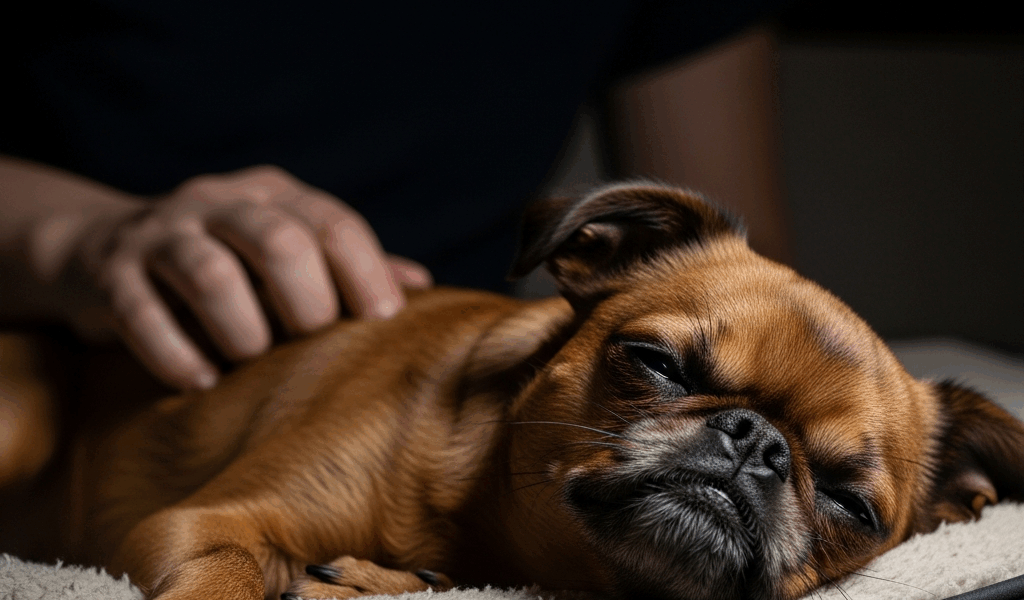
What Normal Griffon Sleep Actually Looks Like
Brussels Griffon sleep has gotten complicated with all the misinformation flying around. As someone who has owned three of these ridiculous little gremlins over the past decade, I learned everything there is to know about their sleep quirks the hard way. Today, I will share it all with you.
First, the number: 12 to 14 hours daily. That’s normal. Not concerning. Not laziness. These dogs pack an almost offensive amount of personality into roughly five pounds of body weight, and all that personality has to go somewhere — apparently it goes into napping.
But what is normal Griffon sleep, exactly? In essence, it’s soft, snuffly, occasionally theatrical rest. But it’s much more than that. You’ll hear gentle rhythmic snoring — not gasping, not choking, just steady little snuffles coming from that pancake face. The Brussels Griffon was deliberately bred with a pushed-in muzzle, so some respiratory noise is baked into the blueprint. My first Griffon, a red rough-coat named Desmond, sounded like a tiny old man sleeping through a Sunday sermon. Completely normal.
You’ll also see twitching. Paws paddling. Muffled little barks at whatever squirrel lives in their dream world. That’s REM sleep doing exactly what it’s supposed to do — a healthy dog processing the day.
Position tells you a lot too. Most Griffons curl tight, stubby legs tucked under, chin resting on their paws. Others sprawl sideways like they’ve given up on dignity entirely. Some sleep sitting upright, pressed against a couch arm or leaned into your leg. That last position — the upright lean — is actually meaningful. It usually means they’re keeping their airway open, even without consciously knowing it.
Spend your first week just watching. Note the snoring volume. Count position shifts per night. Watch the breathing rhythm during deep sleep. That baseline becomes your reference point for everything else.
Sleep Problems Griffon Owners Report Most Often
Probably should have opened with this section, honestly. These are the symptoms driving people to forums at 2 a.m.
- Sudden waking with gasping or choking sounds — The dog jolts awake, sometimes visibly distressed. Not always an emergency, but document how often it happens. Frequent episodes suggest partial airway collapse during sleep — a hallmark of BOAS.
- Snoring that has noticeably worsened — If your Griffon sounded like gentle white noise three months ago and now sounds like a chainsaw hitting gravel, something changed. Weight gain, inflammation, airway narrowing. That trajectory isn’t normal aging.
- Constant nighttime repositioning — Shifting every 30 to 90 seconds, never fully settling. This often pairs with anxiety rather than breathing problems alone. These dogs bond hard to their people, and emotional stress shows up directly in sleep quality.
- Refusing to lie flat — Your Griffon won’t stretch out on their side anymore. They sit, doze, shift, sit again. That’s adaptation — an unconscious attempt to keep the airway from collapsing under its own weight.
- Daytime exhaustion despite spending all night “asleep” — The dog looks tired, moves slow, skips breakfast. That’s not the famous Griffon laziness. That’s fragmented sleep. There’s a difference.
Each symptom points somewhere different, even when they overlap. Generic advice — “give your dog a quiet space” — misses that entirely. Triage works better here.
Why Griffons Are More Prone to Sleep Disruption
The flat face is the breed’s entire charm and its single biggest liability. That pushed-in muzzle means the soft palate, throat tissue, and tongue are all crowded into a shorter space than what you’d find in, say, a Labrador. During sleep, muscles relax. That crowded tissue can shift partially into the airway. That’s brachycephalic obstructive airway syndrome — BOAS. It’s not a disease so much as an architectural reality, but it absolutely wrecks sleep quality.
Narrow nostrils compound everything. Most Griffons don’t have wide nasal openings, so even on a good night they’re working harder to pull air than dogs with longer snouts. Add any inflammation — seasonal allergies, a grain sensitivity, cigarette smoke in the house — and breathing becomes genuinely labored.
Weight is the accelerant owners miss most often. A Brussels Griffon should weigh somewhere between 8 and 10 pounds. I’m apparently a pushover with treats, and my second Griffon, a wire-coat named Petra, crept up to 13.5 pounds before I caught it. The vet was diplomatic about it. I was not — with myself. That extra three or four pounds on a small frame increases pressure on the airway tissue during sleep. More weight, more soft tissue compression, more airway collapse. The math is uncomfortable. Don’t make my mistake.
Then there’s anxiety, which is its own separate beast. Brussels Griffons are velcro dogs in the most literal sense — Desmond once followed me into the bathroom 47 times in a single weekend, I counted — and they do not sleep well when stressed about where their person is. If your Griffon sleeps soundly against your leg but wakes constantly alone in another room, that’s not medical. That’s emotional. Anxiety keeps the nervous system primed just enough to interrupt the drift into deep sleep. The cycle repeats all night and nobody rests.
What to Try Before Calling the Vet
While you won’t need a full veterinary workup on night one, you will need a handful of simple interventions and about two weeks of patience. So, without further ado, let’s dive in.
- Elevate the sleep surface — First, you should prop the head end of their bed up roughly 30 degrees — at least if you want gravity doing some of the airway work for you. A wedge-style dog bed like the Orvis Memory Foam Raised model (around $85–120 depending on size) handles this cleanly. Or slide a folded towel under the head end of whatever bed they already use. Cheap fix. Often effective immediately.
- Cool the room down — 65 to 68°F is the target. Griffons cannot pant efficiently — that flat face again — so they overheat faster than most breeds. A warm room triggers labored breathing, which fragments sleep. A small Honeywell tower fan ($35–45 at most hardware stores) handles both airflow and ambient noise that masks the household sounds triggering anxiety waking.
- Switch to a firm orthopedic bed — Fluffy sinking beds let the dog’s body collapse inward. That compresses the airway. A firm memory foam option — the Big Barker Orthopedic Dog Bed runs about $90–130 and is genuinely worth the price — keeps the spine neutral and the airway uncompressed. That might be the best option, as brachycephalic sleep requires consistent positional support. That is because the airway has almost no margin for postural compression during relaxed muscle states.
- Build a wind-down routine — Twenty minutes before their sleep spot: gentle play, then quiet sitting, then the same location every night. Brussels Griffons are sharp enough to recognize patterns and calm down in response to them. Predictability reads as safety to an anxious dog.
- Audit the food and treat situation honestly — Have you switched brands recently? Added high-fat training treats? Noticed the waist disappearing? Lower-quality proteins and high-fat diets can drive inflammation. I’m apparently someone who hands out Zuke’s Mini Naturals like currency and has to periodically reckon with the consequences. Switching back to a cleaner protein source — something like Orijen or Acana — worked for Petra while the boutique grain-free stuff never did.
Run these changes for two weeks. Document snoring volume, how often they shift, and whether daytime alertness improves. Changes show up in the data before you consciously notice them.
When Sleep Problems Mean a Vet Visit
That’s what makes the breed endearing to us Griffon people — we learn to read them closely enough to catch problems early. These are the signs that mean stop waiting and call the vet today.
- Gasping awake multiple times per night with visible distress. Not once. Multiple times, consistently.
- Gums or tongue appearing blue or gray during or right after sleep. That’s oxygen. That’s urgent.
- Breathing sounds worsening suddenly in an adult dog — and you’ve already ruled out recent weight gain.
- Weight loss alongside sleep changes. Unusual for the breed. Points toward illness rather than anatomy.
- Daytime lethargy so pronounced the dog barely moves or shows interest in food. That’s not a tired Griffon. That’s a sick one.
Find a vet familiar with brachycephalic breeds — not all general practitioners have equal experience here. Mention BOAS by name. They’ll examine the soft palate and nostrils, possibly recommend imaging. For moderate to severe cases, surgery is a straightforward option — soft palate reduction and nostril widening, called a nares resection, are routine procedures. Not experimental. Not drastic. Routine. This new approach to brachycephalic care took off several years ago and eventually evolved into the standard that Griffon owners know and trust today. Many dogs sleep through the night without issue after recovery. Your vet will walk you through that conversation calmly. Let them.

Stay in the loop
Get the latest griffist updates delivered to your inbox.