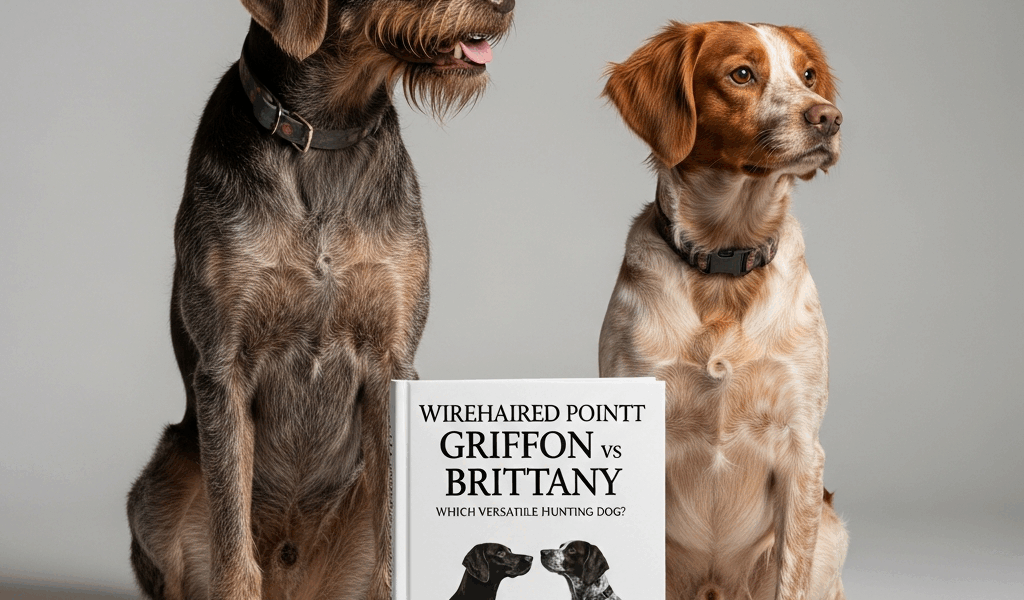
Wirehaired Pointing Griffon vs Brittany — Which Versatile Hunting Dog?
The wirehaired pointing griffon vs Brittany debate comes up every fall in hunting camps, and I’ve had a front-row seat to it for years. I’ve run a WPG named Huck through flooded timber in Arkansas and watched a friend’s Brittany, Pepper, absolutely smoke a South Dakota pheasant field from fence line to fence line. These are both exceptional bird dogs. They’re not interchangeable. If you pick the wrong one for your hunting style, you’ll spend the next decade working around a dog that’s slightly wrong for you — and that gets old fast.
This comparison is built around field performance, not breed club statistics. I’m not going to tell you the Brittany originated in France and the WPG was developed by Eduard Korthals in the 1870s and leave it at that. You can get that from a Wikipedia page. What I want to walk through is what these dogs actually do when you’re standing in a harvested cornfield in November with a limit of roosters in mind, or slogging through a cattail marsh with a box of shells and high expectations.
Field Range and Hunting Style Differences
This is the biggest practical difference between the two breeds, and it’s the thing that should drive your decision more than anything else.
A well-conditioned Brittany on open ground will work 100 to 200 yards out from the handler — sometimes more on flat prairie or open pasture. They’re fast, they cover ground efficiently, and they quarter aggressively. Watching a good Brittany work a pheasant field is genuinely exciting. They’re burning back and forth, pushing into the wind, and when they lock up on a point, it happens decisively. For hunters who walk big country — think Kansas CRP, South Dakota grasslands, Nebraska sandhills — that range and pace is an asset. You cover more acres. You find more birds.
A wirehaired pointing griffon works differently. Most WPGs hunt 50 to 80 yards out, sometimes tighter in heavy cover. They’re not slow dogs, but they’re not ground-eating machines either. They’re methodical. Huck would work a grid through a grouse covert like he was reading it, checking every blowdown and brush pile, quartering with purpose rather than speed. In thick cover — alder runs, cattail edges, briars along a fence line — that closer, more deliberate style means the dog is actually huntable. You don’t need a GPS tracker beeping at 300 yards. You know where the dog is.
The practical implication here is straightforward. If you hunt primarily open fields with predictable bird distribution, the Brittany’s wider range finds more birds in a day. If you hunt mixed terrain — woods to fields to water — the WPG’s shorter, more adaptable range keeps the dog in the picture across all of it.
Cover Type Matters More Than Speed
I made the mistake early on of thinking faster always meant better. A fast dog in thick cover is a dog you’re constantly chasing. Pushed pheasants don’t hold. Grouse flush wild. The WPG’s tighter range in heavy cover isn’t a limitation — it’s a design feature. The Brittany’s wider range in open country isn’t recklessness — it’s efficiency. They’re optimized for different environments.
- Brittany — best for open fields, rolling prairie, agricultural uplands, wide-open pheasant country
- WPG — best for mixed terrain, grouse coverts, heavy cover, water edges, and multi-species days
Coat and Weather — Where the Wirehair Wins
Probably should have opened with this section, honestly, because it’s the most concrete physical difference between these two breeds and it has real consequences on specific hunting days.
The wirehaired pointing griffon has a double coat — a harsh, bristly outer layer and a dense, insulating undercoat. Run your hand against the grain and it feels like stiff brush. That coat is functional armor. Briar patches that would have a short-coated dog bleeding in ten minutes are just background noise to a WPG. I’ve watched Huck crash through hawthorn thickets that would shred a Lab’s face, come out the other side, and immediately lock up on a rooster. The coat sheds briars and burrs more readily than you’d expect, and the undercoat provides legitimate thermal insulation in cold weather.
The Brittany’s coat is medium-length and relatively flat — it’s an attractive coat and easy to maintain, but it’s not a protective coat. In dry summer conditions or early season work, that’s fine. In late October or November, when you’re hunting the second and third week of pheasant season in Iowa or Minnesota, the Brittany starts showing wear. Feet get cut. Chest gets scratched. Cold water retrieves become genuinely uncomfortable for the dog.
Late Season Pheasant and Cold Water — A Real Scenario
Here’s a situation I’ve seen play out multiple times: late November pheasant hunt, ground is frozen, there’s three inches of snow, and the birds have consolidated into the remaining cattail sloughs and heavy grass. The temperature is 22 degrees Fahrenheit. You’re hunting from 9 a.m. to 2 p.m.
A Brittany can absolutely hunt in those conditions, and plenty of hunters run them successfully into December. But the WPG is more comfortable. The harsh outer coat repels snow and ice instead of absorbing it. When a WPG does a water retrieve in 40-degree water — the kind of marginal waterfowl retrieve you might ask a versatile dog to make — they shake off and keep hunting. A Brittany will get cold faster, and depending on body condition and temperature, you’re watching the dog more carefully and hunting shorter sessions.
For waterfowl specifically, the WPG is the clear choice. They were bred with water work as part of the job description. They’re not Labrador Retrievers — don’t expect blind retrieves in big open water — but for close-in duck hunting, flooded timber, or walking up teal on creek edges, a WPG handles cold water confidently. The Brittany can retrieve, but cold-water work isn’t what they were built for.
- WPG advantage — late season hunting in cold, wet, and snowy conditions
- WPG advantage — waterfowl retrieves and water work generally
- Brittany advantage — hot weather early season work, easier post-hunt cleanup
- Brittany advantage — lower grooming maintenance overall
Trainability and Temperament in the Field
Stunned by how differently these two dogs respond to training pressure, I adjusted my entire handling approach when I got my first WPG after years with pointing breeds that tolerated firm corrections.
The Brittany is an eager-to-please dog with a high motor. They’re responsive to training, pick up commands quickly, and can handle more correction than a WPG without shutting down. Most Brittany owners I know have their dogs hunting reliably by the end of the first season — steady to wing and shot, backing other dogs, handling on a whistle. The Brittany wants to work with you. Their high energy can create challenges — they need substantial exercise or they get destructive — but in the field, that energy translates to drive and coverage.
The WPG is softer. That’s not a weakness — it’s a personality trait that requires a different approach. Harsh corrections on a WPG can break their confidence and create a dog that hunts tentatively, constantly checking back for approval instead of trusting its nose. The best WPG trainers I’ve watched use a lot of positive reinforcement, build confidence through success, and are patient with the timeline. Expect the WPG to fully develop into a finished hunting dog somewhere between 18 months and 3 years. Some WPGs are hunting well by month 10. Others need more time to mature mentally before the training really sticks.
Family Life Between Hunts
Both breeds are legitimate family dogs. That’s not a hedge — it’s accurate. But the experience is different.
The Brittany is a high-energy dog seven days a week, not just hunting days. If you have a yard, two kids, and an active lifestyle, the Brittany fits right in. They’ll run with the kids, retrieve tennis balls until your arm falls off, and sleep in a pile with whoever will have them. In a low-exercise household or an apartment, a Brittany is a problem. They need a job or a substitute for one.
The WPG is more adaptable to varied household energy levels. They still need exercise — they’re not couch dogs — but they settle more readily between activities. Huck could go from a three-hour grouse hunt on Saturday to a quiet Sunday afternoon with zero behavioral issues. The WPG’s thoughtful, calm-between-work temperament is genuinely useful for hunters who can’t get out every day.
The Verdict — Which Dog for Which Hunter
No hedging here. Here’s the call, broken down by hunter type.
Get a Brittany If —
You’re an upland-only hunter. You hunt pheasants, quail, or chukar on open ground. You want a fast dog that covers big country, responds quickly to training, and fits into an active family without special handling accommodations. You’re hunting from September through the first two weeks of November and calling it a season. You don’t do water work. You don’t care about cold-weather durability because your season is done before Thanksgiving.
The Brittany is an outstanding bird dog for that specific use case — arguably the most efficient upland hunting dog you can own. At roughly $800 to $1,500 from a reputable hunting-bred breeder (expect to pay toward the high end for FDSB or AKC field-trial lineage), you’re getting a proven field dog with a long track record.
Get a WPG If —
You’re a versatile hunter. You want one dog that handles pheasants in October, grouse in thick timber in November, and ducks in a flooded field in December. You hunt in mixed terrain. You’ve got briar patches and beaver swamps and open fields on the same property. You’re patient with training timelines and you prefer a softer dog you can handle calmly. You want a dog that can spend four nights in a hunting cabin and then come home and be a reasonable house dog without destroying the furniture.
WPG puppies from hunting-bred stock typically run $1,200 to $2,000. NAVHDA-titled parents add cost but signal genuine versatile ability that’s been field-tested under judges, not just marketed on a website. That premium is worth paying.
The Short Version
Brittany — upland specialist. Fast, wide, efficient. Best dog for open-field bird hunting if that’s your primary pursuit.
WPG — versatile generalist. Protective coat, water-ready, adaptable across terrain and weather. Best dog if your season runs long, your terrain runs varied, and your hunting doesn’t stop when the first snow hits.
Both dogs will outperform you on a bad weather day. Both will make you look like a better hunter than you are. Pick the one that matches how and where you actually hunt — not the one that looks best in a breed profile photo.

Stay in the loop
Get the latest griffist updates delivered to your inbox.