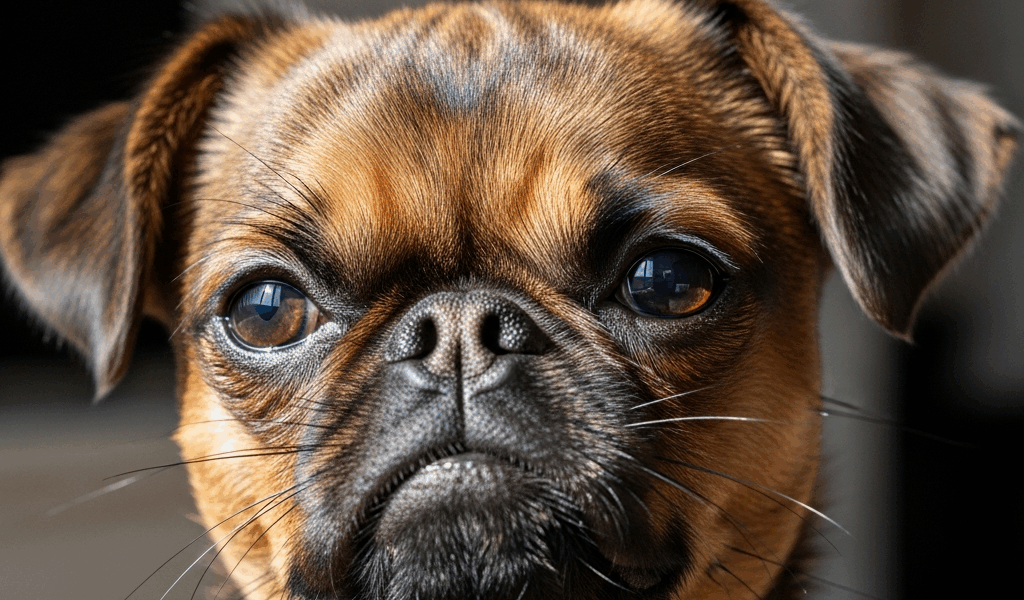
Why Brussels Griffons Get Eye Problems More Than Other Dogs
Brussels Griffon ownership has gotten complicated with all the conflicting advice flying around about their eye care. As someone who has lived with these wrinkle-faced little gremlins for over a decade, I learned everything there is to know about their ocular quirks. Today, I will share it all with you.
Those enormous, forward-facing eyes sit in shallow sockets — barely recessed from the skull surface at all. Pair that with a shortened muzzle and the fact that they blink less than longer-nosed breeds, and you’ve got a genuinely perfect storm for eye trouble. Their tear film spreads unevenly. Their eyelids don’t fully close during sleep. The eye itself has nowhere to retreat. That’s what makes this breed endearing to us Griffon people, honestly — they’re all face, no filter — but it also means eye health demands real attention from day one.
Catching problems early in a Brussels Griffon isn’t just advisable. It’s structurally different from catching them in a Labrador. Small irritations snowball fast. A minor issue can escalate to corneal damage within 48 hours. I learned this personally when my first Griffon, Pepper, developed what I dismissed as “just some redness” on a Friday afternoon. By Monday morning, we were at the emergency vet. Don’t make my mistake.
Discharge and Crusty Corners — What Is Normal and What Is Not
Every Brussels Griffon owner wakes up to crusty corners. It’s part of the deal. That brownish or reddish-tinged discharge matted into the fur below their eyes each morning? Usually harmless. It’s tear overflow — a direct consequence of how their nasolacrimal ducts drain, or more accurately, fail to drain efficiently.
My personal daily baseline: clear to light tan discharge, present only in the morning, minimal staining that wipes away clean with a warm cloth. Cosmetic. Annoying on light-colored fur. Not a flag.
But what is a flag? In essence, it’s any change from that baseline. But it’s much more than just color. Yellow or greenish discharge appearing throughout the day — not just after sleep — matters. Thick, sticky buildup that returns hourly matters. Deep reddish-brown staining spreading across the muzzle, almost like the eye is bleeding tears, matters. These patterns suggest blocked tear ducts or a developing infection. Brachycephalic breeds have tiny, easily congested ducts. Left alone, blockages progress toward conjunctivitis or dacryocystitis — infection of the tear sac itself — neither of which clears up without veterinary help.
Here’s a practical check: on a day with decent natural lighting, look at both eyes side by side. Is one producing noticeably more discharge than the other? Does the color look different from last Tuesday? Does it smell faintly yeasty or sour — almost like old bread? Photograph it. Seriously, take the photo and timestamp it. Then call your vet for an appointment within the week. Not necessarily an emergency slot. Just don’t let it sit.
Redness, Squinting, or Pawing at the Eye
This is the threshold. Redness, squinting, or repeated pawing — any single one of these — means same-day contact with your vet. Not tomorrow. Today.
Brussels Griffons scratch their own eyes easily. Their eye placement is exposed, their paws are constantly near their face, and the scratching itself can cause serious damage even when the original trigger was minor. Corneal ulcers form in hours. I watched it happen to a friend’s Griffon named Biscuit: mild redness on a Tuesday evening, slightly more squinting Wednesday morning, and by Wednesday at 3 p.m. the cornea was abraded. Two weeks of prescription antibiotic drops, four times daily. Her vet bill was $340 — for something that probably started as a piece of dust.
Squinting in normal indoor light is especially important. Most dogs squint occasionally in direct sunlight. A Griffon squinting indoors, or repeatedly in ordinary light, is usually signaling corneal irritation or early ulceration. The eye becomes light-sensitive when it hurts. Some owners also notice the dog seems quieter, holds their head at a slightly different angle, or loses interest in fetch or whatever their usual thing is.
Redness itself comes in flavors. A thin line along the eyelid margin is typically minor — allergy, mild irritation. The entire white of the eye turning bright red, or an eyelid visibly swelling, suggests conjunctivitis or something more inflammatory. Pus-like discharge alongside redness means bacterial infection. That needs antibiotics, prescription-grade, from a vet.
The pawing behavior is where owners second-guess themselves most. It doesn’t need to be frantic or constant to mean something. Even gentle, rhythmic rubbing — the way a dog paws their face absentmindedly — suggests discomfort. They’re not panicking. They’re just trying to make something stop. Trust that signal more than you think you should.
Cloudy Eyes or a Blue-Gray Film Forming
Probably should have opened with this section, honestly, because cloudiness triggers more late-night Googling from Griffon owners than any other symptom — and most of the time, it’s completely harmless.
Nuclear sclerosis is age-related hardening of the lens. In small breeds like Brussels Griffons, it typically appears around age 7 or 8. The eye develops a blue-gray haze, similar in appearance to cataracts but distinctly different in behavior. The haze is uniform. Both eyes are affected symmetrically. Most importantly: it doesn’t significantly impair vision. You notice it before your dog does. By age 10 or 11, most senior Griffons have at least some degree of nuclear sclerosis. It’s aging, not disease. You don’t treat it.
I’m apparently in the minority of owners who finds this comforting, and my vet’s straightforward explanation works for me while dramatic online forums never do. Here’s the home check: in good lighting, look directly into your Griffon’s eyes. Can you still see through the haze clearly to the back of the eye, or does it fully obscure the pupil? Can your dog find treats on a kitchen floor, navigate stairs, move confidently through a dark hallway? If the haziness is uniform, symmetrical, and your dog is functioning normally, nuclear sclerosis is almost certainly your answer.
True cataracts look different. Denser. Often more white than gray. They can appear in one eye before the other, and they develop faster. Most telling: they actually block vision. Your dog bumps into furniture edges, hesitates at the top of stairs, or startles more easily. Cataracts need veterinary evaluation — not just because surgery might be an option, but because they sometimes indicate diabetes or another underlying condition doing the real damage.
Corneal edema — actual swelling of the cornea itself — shows as a blue or milky film. But edema almost never appears alone. It comes with redness, discharge, squinting. If you’re seeing cloudiness in isolation with no other symptoms, edema is unlikely to be your answer.
When to Call the Vet and What to Tell Them
Before you call, gather these specifics — your vet will ask, and having answers ready moves things faster:
- Which eye is affected, or is it both? Approximate timeline — hours or days?
- Has appetite or behavior changed? Any lethargy or unusual quietness?
- Discharge color, as specific as possible — clear, yellow, green, bloody, dark brown
- One-sided or symmetrical presentation?
- Is your dog squinting, pawing at their face, or showing signs of pain like guarding their head?
Most Brussels Griffon eye issues caught early respond well to treatment. Corneal ulcers heal. Bacterial infections clear with the right antibiotics. Blocked tear ducts can be managed long-term. The outcome genuinely depends on catching problems before they compound — and the somewhat ironic good news is that this breed’s exposed, prominent eyes actually work in your favor. You see trouble developing sooner than you ever would in a longer-faced dog. So, without further ado, trust what you’re seeing at home. You know your Griffon’s baseline. That knowledge matters more than any checklist.

Stay in the loop
Get the latest griffist updates delivered to your inbox.